

By Jackson Richman and Joseph Lord
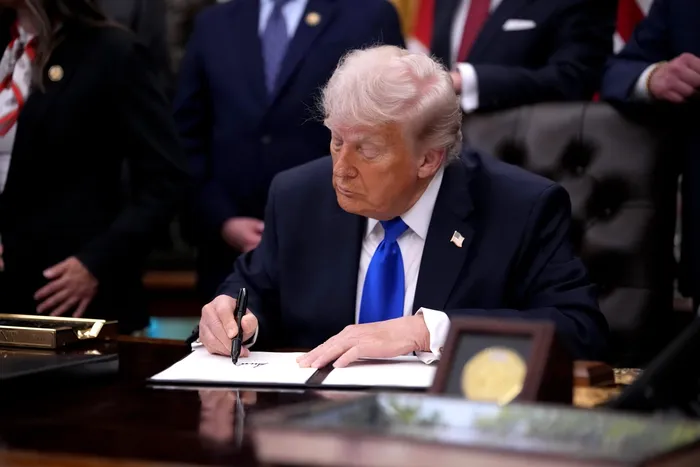
President Donald Trump on April 30 signed legislation ending the Department of Homeland Security (DHS) shutdown after 11 weeks.
The department had been partially shuttered for 76 days since Feb. 14, resulting in long Transportation Security Administration (TSA) lines at airports nationwide.
“After 76 days, the longest government shutdown in history is over,” DHS Secretary Markwayne Mullin posted on X.
“DHS is back open, [Immigration and Customs Enforcement] and [Customs and Border Protection] will be funded through reconciliation (with NO Democrat votes) so liberals can’t play games with federal law enforcement funding. To be clear, this Democrat shutdown NEVER should have happened.”
Calls to pass the bill—and secure funding for presidential protection, which the Senate had already unanimously approved twice—intensified after the April 25 shooting at the White House Correspondents’ Association Dinner in Washington, where prosecutors say a man attempted to assassinate Trump.
The legislation provides funding for all of DHS except Immigration and Customs Enforcement (ICE) and Customs and Border Protection. This includes funding for agencies including the TSA, the U.S. Coast Guard, the Federal Emergency Management Agency, and the Secret Service.
Federal employees in these agencies who had been furloughed and who have mostly gone without pay for the duration of the shutdown will return to work and receive back pay.
Funding for immigration enforcement has been separated from the main DHS funding bill, and Republicans instead plan to pass immigration funding via the reconciliation process.
House Speaker Mike Johnson (R-La.) had dismissed the legislation as a “joke” in March.
Johnson on April 30 defended the decision to delay consideration of the broader DHS bill, saying that House Republicans first wanted to see progress on funding for ICE and Border Patrol.
“We held the [DHS] bill, the underlying funding bill, because we had to ensure that they could not isolate and eliminate those two critical agencies,” he said. “We are getting those done now.”
In a late vote on April 29, House Republicans approved the budget resolution for ICE and Border Patrol in a near party-line 215–211 vote. The measure would provide $70 billion for immigration enforcement and deportations through the remainder of Trump’s term, which ends in January 2029, while shielding the funding from Democratic obstruction.
Afterward, Johnson acknowledged his earlier criticism of the bill and said separating immigration enforcement money into its own budget track made the proposal acceptable, allowing it to pass “with no controversial Democratic provisions.”
Democrat Demands for ICE
Funding for most of the DHS expired on Feb. 14, as Democrats pushed Republicans and the White House to agree to new limits on ICE and Border Patrol. They argued that immigration enforcement agencies should follow the same standards as police departments nationwide, including obtaining judicial warrants before entering private residences. However, after weeks of talks, negotiations reached a deadlock.
Democrats had a core list of demands before they would back additional funding for DHS, centering around the rules governing on-the-ground immigration enforcement.
Their demands have included requiring ICE and other immigration enforcement agents to show identification, disallowing face coverings while carrying out official duties in public, and instituting legislative prohibitions against administrative warrants, or warrants the administration grants itself.
Republicans have opposed these proposals, particularly a prohibition on masking. They say that the measure would be anti-police.
As such, funding for ICE and Border Patrol will be considered separately under a reconciliation bill that can be passed without any Democratic support.
Specifically, Republicans are using the reconciliation process to pursue up to $70 billion in funding for immigration enforcement through the end of Trump’s term. Both chambers have approved legislation to begin drafting the bill.
Under the reconciliation process, which is governed by strict rules, lawmakers can bypass the normal filibuster requirements and pass party-line legislation in the upper chamber.
Because reconciliation is excepted from filibuster rules, it has been an appealing tool for both parties when failing to secure a supermajority in the Senate. It was used by Democrats to pass the Inflation Reduction Act of 2021 and by Republicans to pass the One Big Beautiful Bill Act of 2025, but it is subject to significant restrictions.
Namely, it must include only federal budget items, with no items that have a “merely incidental” effect on revenue or spending.
Senate Majority Leader John Thune (R-S.D.) indicated that Republicans had been forced to use the process to end the shutdown affecting DHS.
“It’s not my preference, but it is reality,” Thune said.
DHS Funding Nearly Exhausted
The White House had pressed Congress to act, warning that stopgap funding Trump used to temporarily pay TSA and other DHS workers through executive actions was nearing exhaustion.
In a memo released on April 28, the Office of Management and Budget warned that DHS could soon deplete critical operating funds, jeopardizing essential staff and operations. Even so, most department employees have remained on the job because they are classified as essential.
Immigration enforcement personnel have largely been paid through roughly $170 billion approved by Congress last year as part of Trump’s tax cuts package. Other workers, including TSA agents, have relied on executive measures to continue receiving paychecks.
With payroll costs topping $1.6 billion every two weeks, Mullin recently warned that available funds were quickly running out.
According to The Associated Press, Airlines for America said more than 1,000 TSA officers resigned since the shutdown began.
Reuters contributed to this report.