

By Matthew Vadum
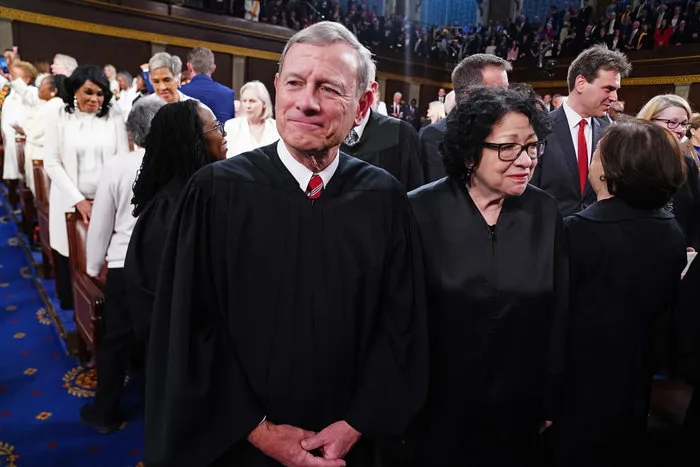
Chief Justice John Roberts said on Dec. 31 that as the United States prepares to celebrate its 250th anniversary in 2026, the U.S. Constitution and the Declaration of Independence remain sources of inspiration for Americans.
The comments, which did not reference any recent or currently pending Supreme Court cases, came in Roberts’s annual year-end report on the state of the federal judiciary.
As chief justice of the United States, Roberts presides over oral arguments and private conferences at the Supreme Court. He also oversees the entire federal judiciary.
In the report, Roberts quoted President Calvin Coolidge, who praised the two foundational documents a century ago on the occasion of the nation’s 150th anniversary.
“Amid all the clash of conflicting interests, amid all the welter of partisan politics, every American can turn for solace and consolation to the Declaration of Independence and the Constitution of the United States with the assurance and confidence that those two great charters of freedom and justice remain firm and unshaken,” the 30th president said.
Roberts added: “True then; true now.”
A quarter millennium after the Declaration was adopted in 1776, it remains “one of the most widely read and emulated political documents in history,” Roberts wrote.
The Declaration’s preamble “articulates the theory of American government in a single passage that has been hailed as ‘the greatest sentence ever crafted by human hand,’” he said.
The preamble states: “We hold these truths to be self-evident, that all men are created equal, that they are endowed by their Creator with certain unalienable Rights, that among these are Life, Liberty, and the pursuit of Happiness.”
That introductory passage gave voice to “a national mission statement, even though it quite obviously captured an ideal rather than a reality, given that the vast majority of the 56 signers of the Declaration … enslaved other humans at some point in their lives,” the chief justice wrote.
Over time, the nation moved closer to realizing its ideals with “national accomplishments,” such as the ratification of the 19th Amendment, which, when it took effect in 1920, gave women the right to vote, and the enactment of the landmark Civil Rights Act of 1964, Roberts wrote.
Responsibility for “living up to the promises of the Declaration [rests] on all three branches of our government as well as on each successive generation of Americans,” he said. Members of the judicial branch “must continue to decide the cases before us according to our oath, doing equal right to the poor and to the rich, and performing all of our duties faithfully and impartially under the Constitution and laws of the United States,” Roberts wrote.
Roberts stressed the importance of judicial independence, noting that the Declaration protested the degree of control that Great Britain’s King George III exercised over the judiciary.
“The Constitution corrected this flaw, granting life-tenure and salary protections to safeguard the independence of federal judges and ensure their ability to serve as a counter-majoritarian check on the political branches,” Roberts wrote. “This arrangement, now in place for 236 years, has served the country well.”
Roberts did not reference his own remarks from March 2025, in which he seemed to push back against President Donald Trump’s calls to impeach U.S. District Judge James Boasberg for ruling against one of his policies. Boasberg issued an order halting deportation flights after the president said he had the authority to expeditiously deport alleged members of a foreign terrorist group under the Alien Enemies Act of 1798.
Trump signed a proclamation in March 2025 declaring that Tren de Aragua was a designated foreign terrorist organization associated with Venezuela and that it was “perpetrating, attempting, and threatening an invasion or predatory incursion against the territory of the United States.”
The next month, the Supreme Court granted Trump’s request to pause the orders of Boasberg but determined that detainees must be given an opportunity to challenge their removal.
Trump wrote on Truth Social that Boasberg should be impeached.
Trump said the judge “was not elected President.”
“We don’t want vicious, violent, and demented criminals, many of them deranged murderers, in our country,” the president wrote, in all capital letters.
Roberts said in March 2025 that for more than 200 years, impeachment has not been considered “an appropriate response to disagreement concerning a judicial decision.”
“The normal appellate review process exists for that purpose,” he added at the time.
In the report, Roberts wrote that in the early 1800s, an effort to impeach Supreme Court Justice Samuel Chase went down to defeat because “many senators concluded that disapproval of a judge’s decisions provided an invalid basis for removal from office.”
Roberts quoted former Chief Justice William Rehnquist, who said that the outcome of the Chase affair “assured the independence of federal judges from congressional oversight of the decisions they made in the cases that came before them.”
Sam Dorman contributed to this report.
Related posts:
 Supreme Court Will Hear Trump’s Birthright Citizenship Case
 Biden Administration Asks Supreme Court Not to Take Up ‘Insular’ Citizenship Cases
 Gingrich: New Trump Special Counsel Is a ‘Left Wing Hatchet Man’
 The Art of Stealing Elections: How the DNC Manipulates Polls, Media, and Voter Fraud to Control Outcomes