
By Tom Ozimek
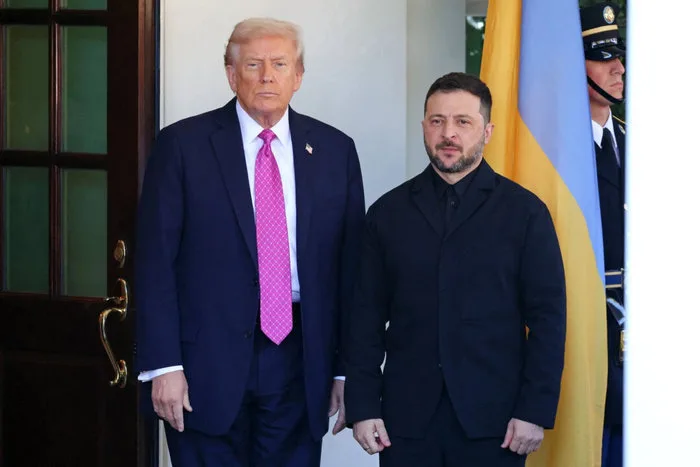
Ukrainian President Volodymyr Zelenskyy said on Dec. 26 that he will meet President Donald Trump in Florida this weekend, with talks scheduled for Sunday, raising hope that direct leader-level discussions could accelerate efforts to end the war in Ukraine.
In remarks to journalists, Zelenskyy said the two leaders will discuss security guarantees for Ukraine, territorial issues, and a draft political framework for ending the conflict that he said is now “about 90 percent ready.”
He added that an “economic agreement” would also be on the agenda, though he cautioned that it was unclear whether any deal would be finalized by year’s end.
In a social media post earlier Friday, Zelenskyy said that Rustem Umerov, head of Ukraine’s National Security and Defense Council, had briefed him on the latest contacts with U.S. officials and that preparations were underway for a meeting with Trump.
“We are not losing a single day. We have agreed on a meeting at the highest level—with President Trump in the near future,” Zelenskyy wrote. “A lot can be decided before the New Year.”
Zelenskyy’s confirmation followed his Christmas Eve appeal for a direct meeting with the U.S. president to address what he has described as the most sensitive and unresolved issues in a potential peace agreement with Moscow—chief among them territorial control and security guarantees.
The Ukrainian leader said those questions could only be settled at the leaders’ level after Ukrainian and U.S. negotiators finalized a political framework for ending the conflict. That framework has been narrowed to 20 points from an earlier 28-point draft that Kyiv and its European allies criticized as overly favorable to Russia.
Talks Intensify as Year Ends
Zelenskyy said the revised draft was hammered out during talks in Florida over the weekend between Ukrainian delegates and a U.S. team led by special envoy Steve Witkoff and Trump’s son-in-law Jared Kushner.
“This is a document referred to as a framework—a foundational document on ending the war, a political document between us, America, Europe, and the Russians,” Zelenskyy told journalists during a Dec. 23 briefing, during which he outlined the latest 20-point peace plan.
“We are ready for a meeting with the United States at the leaders’ level to address sensitive issues. Matters such as territorial questions must be discussed at the leaders’ level.”
On Dec. 25, Zelenskyy said he spoke for nearly an hour with Witkoff and Kushner, calling it a “truly good conversation” that helped establish timing and formats for pushing the peace process forward.
“We have some new ideas in terms of formats, meetings, and, of course, timing on how to bring a real peace closer,” he said, adding that more talks between Umerov and the U.S. team were expected later in the day.
“Some documents are already prepared. … Of course, there is still work to be done on sensitive issues. But together with the American team, we understand how to put all of this in place. The weeks ahead may also be intensive.”
Zelenskyy also said he would be speaking with European leaders about the plan to ensure unity around the plan.
“Real security, real recovery, and real peace—this is what must be achieved,” he said.
Moscow Sees ‘Slow but Steady’ Progress
Russia has offered a more cautious assessment. On Dec. 25, Foreign Ministry spokeswoman Maria Zakharova said negotiations with Washington were making “slow but steady progress,” while accusing Western European governments of attempting to derail diplomatic efforts.
“In the negotiation process on a settlement of the Ukraine conflict … there is slow but steady progress,” Zakharova told reporters in Moscow, urging the United States to counter what she described as “malicious attempts” by European allies to undermine talks.
Her remarks followed comments by Russian President Vladimir Putin, who said at a Dec. 17 meeting with defense officials that Moscow would pursue its war aims “unconditionally.”
“If they do not want a substantive discussion,” Putin said, “then Russia will liberate its historical lands on the battlefield.”
Kremlin spokesman Dmitry Peskov said Russia was reviewing recent developments after receiving a report from Kirill Dmitriev, a negotiator involved in the U.S. talks, and would continue contacts “as soon as possible.”
Russian Deputy Foreign Minister Sergey Ryabkov reiterated Moscow’s opposition to a temporary cease-fire, saying Russia wanted a “sustainable cessation of hostilities” addressing what it calls the conflict’s root causes, including territorial claims and security arrangements.
Kyiv Says Deal Is Close
While Russian officials have struck a cautious tone on progress in talks, Zelenskyy said on Dec. 22 that negotiations with the United States and Europe were “very close to a real result.” At the same time, the Ukrainian leader said that Russia continued to reject genuine cease-fire proposals while pressing its military campaign.
According to Zelenskyy, the current talks focus on a 20-point plan largely reflecting a joint Ukrainian-American position, but with several unresolved issues.
Kyiv favors ending hostilities along current battle lines, while Moscow wants Ukrainian forces to withdraw from the entire Donetsk region, parts of which remain under Ukrainian control. Another major sticking point is control of the Zaporizhzhia facility, Europe’s largest nuclear plant.
Trump, who has spearheaded efforts to bring both sides to the table and end the war, told reporters on Dec. 23 that talks were “going along,” while noting “tremendous hatred” between Zelenskyy and Putin.
He said he would do what is necessary to end a war that he said “everyone is tired of,” as preparations move forward for a possible meeting with the Ukrainian leader.
The Associated Press contributed to this report.