

By Panos Mourdoukoutas
Stocks moved lower this week as surging oil prices and rising bond yields weighed on investor sentiment. The escalation of the U.S.-Iran conflict fueled fears of stagflation—a challenging environment for both equities and fixed-income securities.
Adding to the uncertainty was a labor market report released late in the week that pointed to job losses, possibly linked to unusually severe weather conditions. Smaller-cap stocks and consumer discretionary companies—both highly sensitive to interest rates and economic conditions—were among the hardest hit sectors.
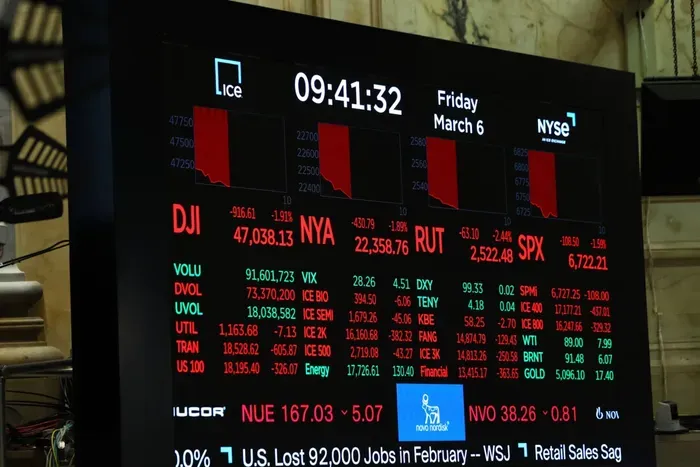
For the week, the Dow Jones Industrial Average fell by 3.01 percent to 47,501, close to its weekly low reached on March 6. The S&P 500 declined by 2.02 percent to 6,740, also near the weekly low. The Nasdaq Composite dropped by 1.24 percent, while the Russell 2000 posted the largest decline, 4.07 percent.
Market volatility rose sharply. The Chicago Board Options Exchange Volatility Index ended the March 6 session at 29.49, up by 48.49 percent for the week.
Stocks opened the week on March 2 under pressure as the U.S.–Iran conflict entered its third day. Rising oil prices fueled renewed inflation concerns, prompting investors to adopt a more cautious stance.
Inflation fears were amplified by a surge in the ISM Manufacturing Prices Index, which rose to 70.5 in February from 59 the previous month. The reading came in well above the 59.5 estimate and marked the fastest increase in the sector’s inflation gauge since June 2022.
Rising inflation concerns triggered a sell-off in bonds, sending the yield on the 10-year U.S. Treasury note up by more than 10 basis points to 4.05 percent, reversing the previous week’s downward trend.
Higher yields typically weigh on equities by compressing valuations. Major indexes—including the Dow, S&P 500, Nasdaq, and Russell 2000—opened the session with losses exceeding 1 percent.
Companies that consume large amounts of fuel, such as airlines and cruise operators, declined sharply, while interest-rate-sensitive sectors such as homebuilders also came under pressure. In contrast, oil producers, including Chevron and Exxon Mobil, rallied alongside rising crude prices.
Selling pressure eased by late morning trading as bargain hunters stepped in, helping most equity indexes recover and close mixed, with the Dow the only major index finishing in negative territory.
“Investors should not fret one day of market volatility, especially since stock valuations have been elevated for some time now,” David Bahnsen, chief investment officer at The Bahnsen Group, based in Newport Beach, California, told The Epoch Times.
“Over the long-term, geopolitical events don’t affect markets, and we’ve been through decades of instances with heightened tensions in the Middle East, and stocks continue to grind higher.”
Bahnsen expects the energy sector to continue outperforming, citing supply constraints, rising demand, and more attractive valuations relative to technology stocks.
“Investors are getting tired of tech valuations and tired of the AI hype,” he said.
The March 2 session followed a similar pattern, with equities again under pressure as the U.S.–Iran conflict entered its fourth day and oil prices continued climbing, reinforcing expectations of higher inflation and bond yields.
All major indexes opened sharply lower but pared losses in the afternoon trading as oil prices, which peaked around 10 a.m. ET, eased slightly later in the day while still closing higher overall.
Despite the partial recovery, all major indexes closed in the red, led by the Russell 2000 and the Nasdaq, which declined by 1.79 percent and 1.02 percent, respectively.
There were some bright spots in the retail sector. Shares of Target and Best Buy gained by 6.74 percent and 7.08 percent, respectively, as investors reacted to improving turnaround prospects.
“The Iran strikes began several days ago, and the stock market is still grappling with some aftershocks, as investors digest the news and assess whether Monday’s muted initial stock declines and dramatic recovery were justified,” Robert Edwards, chief investment officer at Naples, Florida-based Edwards Asset Management, told The Epoch Times.
“While there may be additional conflict, casualties, and disruption in the Middle East, stocks have a way of moving on from geopolitical events, and we expect stocks to continue their grind higher once the market finishes pricing in the Iran escalation,” he said.
Markets turned higher on March 4 amid hopes of a de-escalation in the U.S.–Iran conflict. Stabilizing oil prices helped ease fears of another surge in global inflation and additional monetary tightening.
Aiding sentiment was a new ADP report showing that private businesses in the United States added 63,000 jobs in February, the most since July 2025 and above forecasts of 50,000.
The Federal Reserve’s Beige Book, released later in the session, described a mixed economic picture in February, with seven of the 12 Federal Reserve districts reporting moderate growth. The report helped revive hopes that monetary policy could remain accommodative.
The rebound was broad, with all major indexes closing firmly higher. The Nasdaq and Russell 2000 led the gains, rising by 1.29 percent and 1.06 percent, respectively.
The March 5 trading session saw renewed pressure as oil prices climbed again, reigniting inflation concerns and weighing on credit markets.
The yield on the U.S. 10-year Treasury note rose for a fourth consecutive session to 4.14 percent, the highest level in about a month.
Another labor market report also contributed to upward pressure on yields. The Challenger report showed U.S.-based employers announced 48,307 job cuts in February, down from 108,435 in January and well below 172,017 a year earlier.
Even so, equity markets trimmed some of their earlier losses as dip buyers re-entered the market during the final hour of trading. The Nasdaq and S&P 500 ended the day with moderate losses of 0.26 percent and 0.56 percent, respectively, while the Dow and Russell 2000 posted steeper declines of 1.61 percent and 1.91 percent.
Selling pressure returned on the final trading day of the week as oil prices continued to climb, surpassing $90 a barrel and reinforcing inflation fears.
At the same time, a weaker-than-expected labor report added to concerns about a potential economic slowdown. The economy shed 92,000 jobs in February—the largest decline in four months—well below expectations of a 59,000 gain. Employment in the health care sector fell by 28,000, reflecting strike activity.
“So far, U.S. indices have done a pretty good job absorbing a bevy of headlines—whether that’s worries over AI, macro concerns, or geopolitical developments. Should these headlines ease, and market fundamentals remain resilient, that sets up a plausible path to higher prices as 2026 progresses,” an eToro U.S. investment analyst told The Epoch Times.
“However, should further turbulence surface, retail investors will need to do what they’ve been practicing for years: Stay disciplined, manage position sizing, and ride out the drawdowns without turning every headline into a portfolio decision,” he said.