


By Chris Summers
Ukrainian President Volodymyr Zelenskyy said on Dec. 9 he was prepared to hold elections within three months if his allies in the West could ensure the vote was secure and fair.
Zelenskyy was responding to an interview U.S. President Donald Trump gave to Politico in which he said it was time for Ukraine to hold an election.
“I think it’s an important time to hold an election,” Trump said.
“They’re using war not to hold an election, but I would think the Ukrainian people should have that choice. And maybe Zelenskyy would win. I don’t know who would win.
“But they haven’t had an election in a long time. You know, they talk about a democracy, but it gets to a point where it’s not a democracy anymore.”
When Was Zelenskyy Elected?
In 2019, Zelenskyy, a former comedian and actor who was then 41, won 73 percent of the vote in the second round of the presidential election, defeating the incumbent, Petro Poroshenko.
In the popular Ukrainian television show “Servant of the People,” Zelenskyy played a schoolteacher who becomes the Ukrainian president after delivering a speech about government corruption that goes viral online.
Zelenskyy was elected five years after ethnic Russian separatists in eastern Ukraine and Crimea broke away from Kyiv in response to Ukrainian President Viktor Yanukovych’s ousting by pro-EU protesters in February 2014. Yanukovych, who was seen as pro-Russian, fled to Moscow.
That same year, Russia annexed the Crimean peninsula, following a referendum that was declared illegal by the government in Kyiv.
In December 2019, Zelenskyy and Russian President Vladimir Putin met face-to-face in Paris for talks, but the negotiations went nowhere.
Elections Suspended
Zelenskyy’s five-year term as president was due to end in May 2024, but elections have been suspended since martial law was declared, after Russia invaded on Feb. 24, 2022.
Russia held a presidential election in March 2024, in which Putin, then 71, was reelected by a comfortable margin.
Although Russia was at war, unlike Ukraine, it did not have a portion of its territory under enemy occupation.
Currently, elections are forbidden under martial law in Ukraine, but Zelenskyy has said he is willing to try to change the law to allow wartime elections, even in a partly-occupied country.
“I’m ready for elections, and moreover, I ask … that the U.S. help me, maybe together with European colleagues, to ensure the security of an election,” Zelenskyy said on Dec. 9.
“And then in the next 60–90 days, Ukraine will be ready to hold an election.”
A poll by the Kyiv International Institute of Sociology found that only 25 percent of Ukrainians approved of elections following a cease-fire and security guarantees, and 57 percent believed they should only be held after a final peace agreement was reached. The pollsters questioned 547 people in Ukrainian-controlled territory.
Who Would Run Against Zelenskyy?
In an interview with Axios published on Sept. 25, Zelenskyy said he would be ready to step down after the war with Russia is over, and would not seek a second term.
But assuming an election were held during a pause in the fighting, Zelenskyy would likely be a candidate.
A poll by Info Sapiens published on Dec 9 suggested Zelenskyy was the most popular candidate, with 20.3 percent of Ukrainians saying they would vote for him in the next presidential elections.
The second most popular choice in the Info Sapiens poll was the former commander-in-chief of Ukraine’s armed forces, General Valerii Zaluzhnyi, who garnered 19 percent.
Zaluzhnyi, 52, was in charge of Ukraine’s defenses during the battle for Kyiv in early 2022, and counteroffensives up until May 2024, when he was made ambassador to London.
In August, Zaluzhnyi’s media adviser, Oksana Torop, denied reports in the Ukrainian media that he was setting up a campaign headquarters in London. The reports were based on a post on X by freelance U.S. journalist Katie Livingstone in Kyiv.
“I do not recognize any idea of holding an election during a war,” Zaluzhnyi posted on Facebook on Oct. 8.
“Anyone who receives an offer from something like my surname to join any process through any organization should report it to law enforcement.
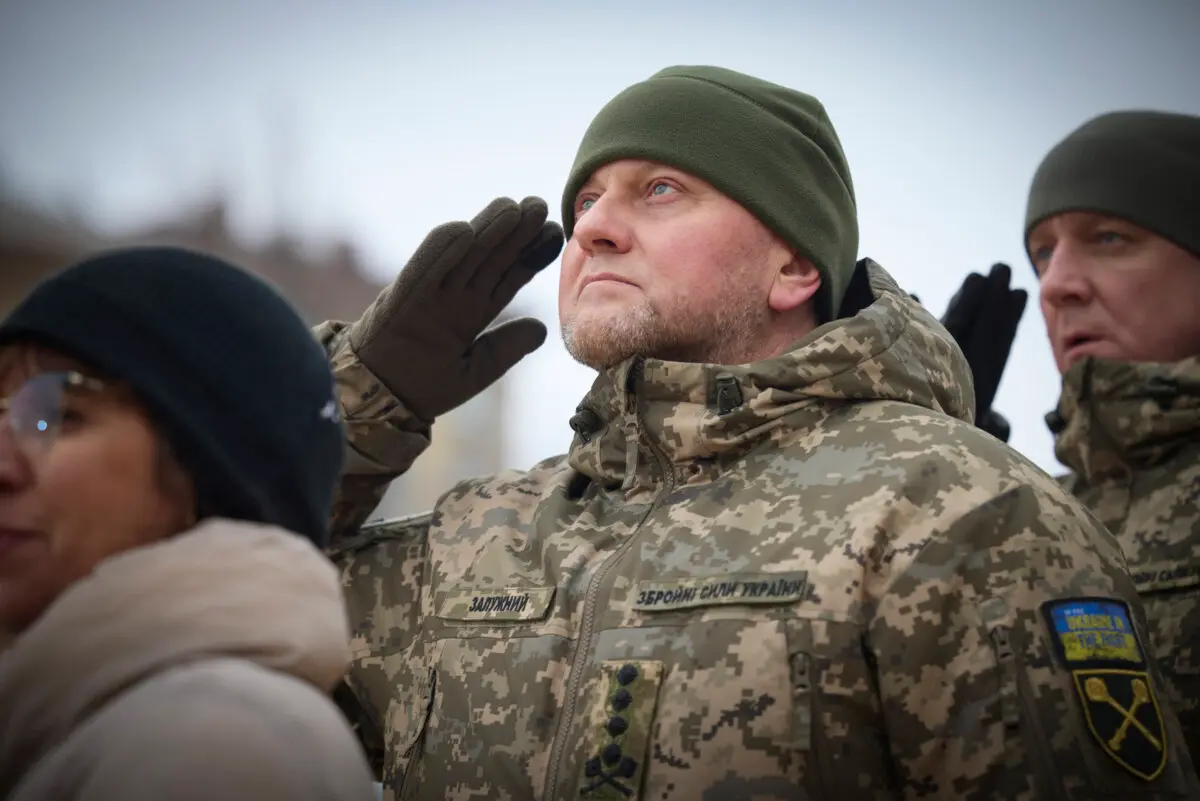
“I do not create headquarters, no parties, and have no ties with any political force in principle.”
Poroshenko could be a candidate, and there could be a run from Yulia Tymoshenko, a former prime minister who was the front-runner in the opinion polls in 2019 but failed to secure enough votes to reach the second round.
Other names suggested in the Info Sapiens poll include Kyrylo Budanov, chief of Ukraine’s defense intelligence; the former commander of the Third Army Corps, Andriy Biletskyy; former world heavyweight boxing champion Vitali Klitschko, who is mayor of Kyiv; and the current world heavyweight champion, Oleksandr Usyk.
Voting in Occupied Territory
There would be significant logistical difficulties in holding an election—even in the event of an enduring cease-fire—when around a fifth of Ukraine is under Russian occupation.
Crimea, most of the Donetsk and Luhansk regions, and the majority of the oblasts of Kherson and Zaporizhzhia are either controlled by Russia or on the frontline.
Significant numbers of Ukrainian civilians have fled those areas, while many others have been killed.
Shortly before elections were held in Russian-occupied Ukraine in September 2023, a report by two nonprofits—Eastern Human Rights Group and the Institute for Strategic Research and Security—said 42 percent of the candidates were Russian citizens with no previous connection to the region.
The British government later sanctioned several individuals and the Central Election Commission (CEC) of Russia, saying the agency arranged what it described as “sham elections.”
CEC Secretary Natalya Budarina has also been sanctioned by the United States.
Wartime Elections
Elections have been held in wartime in other countries.
The United States has a proud record of never having canceled or postponed presidential or mid-term elections, even during the Civil War.
In November 1864, Abraham Lincoln was reelected president, defeating Democratic Gen. George McClellan, but there was no voting in the states then held by the Confederacy.
Franklin D. Roosevelt was also reelected president in 1944, during World War II, although no U.S. territory was under occupation by Axis powers. Roosevelt died just three months after his inauguration, in April 1945, and was succeeded by his vice president, Harry Truman.
Britain, which has no written constitution, suspended elections during World War II. An election was held in July 1945—10 years after the previous election— after the end of the war in Europe.
The Conservative Party, led by wartime Prime Minister Winston Churchill, was defeated by the Labour Party, headed by Clement Attlee, who became the prime minister.
Related posts:
 ‘We Do Not Support’: World Leaders Turn Against Biden for Giving Ukraine Cluster Munitions
 Suspected Drone Fragments Found in Romania After Russian Air Attacks Over Ukraine
 Spain Offers $946 Million in Ukraine Aid Package During Zelenskyy Visit
 Kremlin Says Ukraine Tried to Attack Putin’s Residence, Peace Deal Stance Under Review