
By Emel Akan
WASHINGTON—U.S. President Donald Trump hosted Venezuelan opposition leader María Corina Machado for a lunch meeting at the White House on Jan. 15.
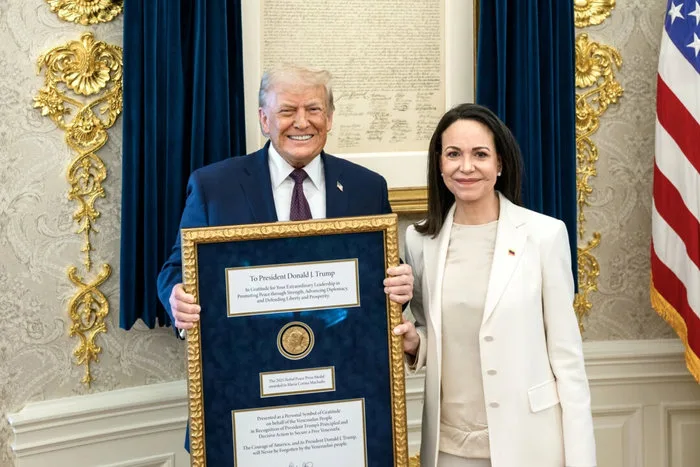
Speaking to reporters after the meeting, Machado said she presented Trump with the gold Nobel Peace Prize medal she received in Oslo, Norway. She was awarded the peace prize in December 2025 for her fight for democracy in Venezuela.
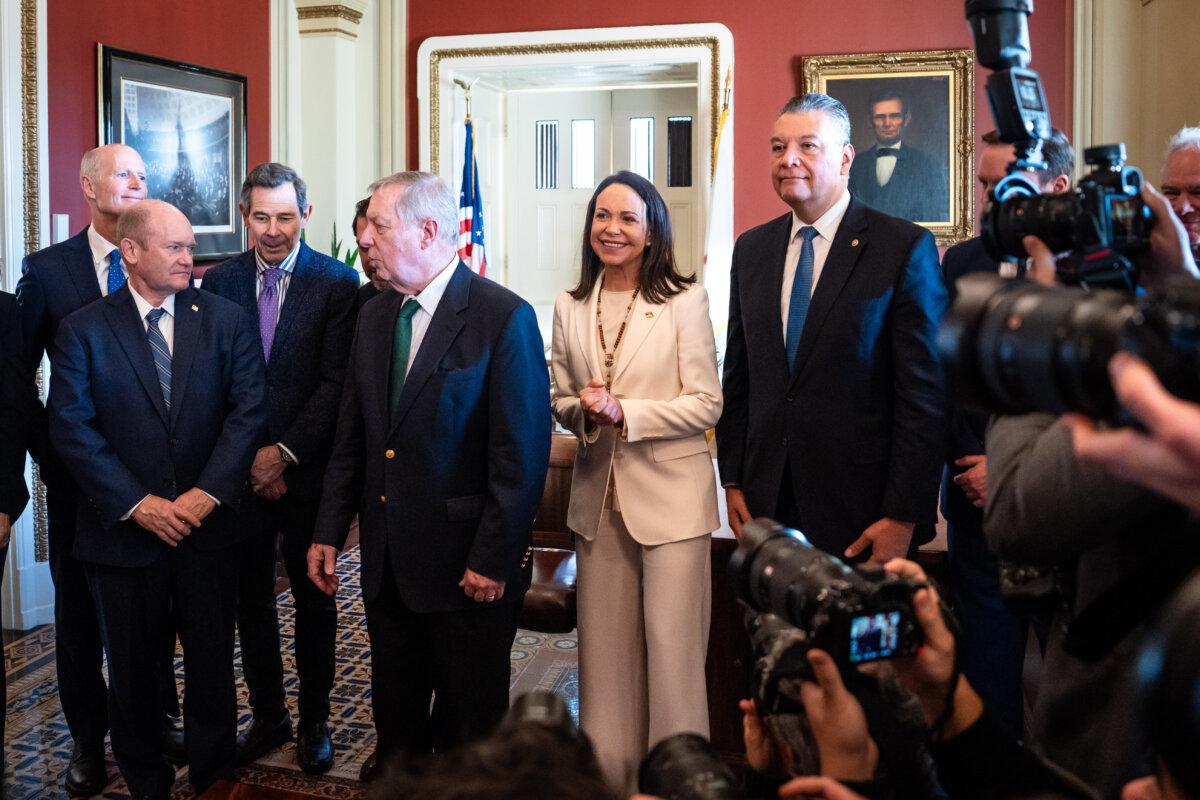
After her nearly two-hour meeting at the White House, Machado headed to Capitol Hill to meet with lawmakers.
Trump confirmed in a Truth Social post that he received the medal, calling it “a wonderful gesture.”
“It was my Great Honor to meet María Corina Machado, of Venezuela, today. She is a wonderful woman who has been through so much,” Trump wrote. “María presented me with her Nobel Peace Prize for the work I have done. Such a wonderful gesture of mutual respect. Thank you María!”
Outside the Capitol, Machado said that presenting the Nobel medal was intended to recall an event 200 years ago, when the Marquis de Lafayette gave Simón Bolívar a medal bearing George Washington’s likeness. She said Bolívar kept the medal “as a symbol of the connection between the struggle for independence in America and the fundamental values of the United States” and noted that that is what she wanted to emphasize.
Trump had earlier expressed doubts about Machado’s prospects of leading Venezuela. At a Jan. 15 press briefing, White House press secretary Karoline Leavitt said the president’s earlier comments were “based on realities on the ground.”
“It was a realistic assessment based on what the president was reading and hearing from his advisers and national security team, and at this moment in time, his opinion on that matter has not changed,” Leavitt said.
Trump’s meeting with Machado comes in the wake of a U.S. military operation early in January that resulted in the capture of Venezuelan leader Nicolás Maduro from Venezuela’s capital city of Caracas.
“She’s a very nice woman,” Trump told Reuters in a Jan. 14 interview. “I think we’re just going to talk basics.”
Just hours after Maduro’s capture, Trump said “it would be very tough” for Machado to be the leader.
“She doesn’t have the support within or the respect within the country,” Trump said at the time. “She’s a very nice woman, but she doesn’t have the respect.”
Machado was banned from running for president by Venezuela’s Maduro-run Supreme Tribunal of Justice in January 2024.
She went into hiding and was succeeded by Edmundo González Urrutia. In the disputed 2024 election, both the United States and the European Union recognized González as the rightful president-elect.
Machado said in July 2024 that González won the election with 70 percent of the vote and that the results showing Maduro as the winner were fraudulent. Then-U.S. Secretary of State Antony Blinken agreed.
“Given the overwhelming evidence, it is clear to the United States and, most importantly, to the Venezuelan people that Edmundo González Urrutia won the most votes in Venezuela’s July 28 presidential election,” Blinken said in a statement at the time.
After being captured by the U.S. military, Maduro and his wife, Cilia Flores, were transferred to New York City on Jan. 3 and are currently being held in custody. At their first court appearance on Jan. 5, both pleaded not guilty to federal charges that include drug trafficking and collaborating with gangs designated as terrorist organizations. Maduro told the court that he is still the president of his country and that he was kidnapped.
Delcy Rodríguez, Maduro’s deputy, is currently, alongside many members of Maduro’s inner circle, in charge of day-to-day government operations in Venezuela.
Trump said on Jan. 14 that he had a “great conversation” with Rodríguez, the first direct communication between the two since Maduro was ousted.
“We had a call, a long call,” Trump told reporters. “We discussed a lot of things. And I think we’re getting along very well with Venezuela.”
Joseph Lord contributed to this report.