
By John Haughey
Iran’s de facto closure of the Strait of Hormuz and partial destruction of Qatar’s liquified natural gas (LNG) infrastructure on March 18 will have a dramatic global impact, primarily in East Asia, but won’t affect North American natural gas prices, market analysts say.
“The price of natural gas in the United States has not been affected because the domestic market is ‘shielded’ from international price spikes,” said Ken Medlock, an energy market researcher at Rice University’s Baker Institute for Public Policy.
In fact, natural gas prices in the United States and Canada are expected to decline as winter fades, he told The Epoch Times.
The United States is the world’s largest LNG exporter, eclipsing Qatar and Australia in 2022, with domestic producers now supplying 25 percent of global consumption, data from the U.S. Energy Information Administration show. Nearly 70 percent is shipped to buyers in Europe, with Japanese and South Korean consumers increasing imports over the past few years.
Qatar, meanwhile, is the world’s second-largest LNG exporter, supplying nearly 20 percent of global demand. About 90 percent of Qatari LNG is purchased by buyers in Asia, including China, South Korea, Japan, India, and Pakistan.
Iranian attacks since March 4 had already knocked out 17 percent of the Gulf state’s LNG export capacity before the March 18 missile strike caused massive damage to the Ras Laffan Industrial City Pearl GTL (gas-to-liquids) plant and destroyed at least two of 14 “trains,” sequential components that purify and cool natural gas to turn it into liquid for transport.
QatarEnergy CEO Saad al-Kaabi said on March 19 that the damage will take years to repair, prompting the company to declare “force majeure” on contracts for up to five years. Force majeure means an unexpected event, such as a war, a natural disaster, or a government action that prevents the fulfillment of a contract.
Alex Munton, director of the Washington-based Rapidan Energy Group Global Gas and LNG Service, told The Epoch Times that the five-year estimate implies infrastructure must be rebuilt rather than repaired, meaning that even when shipping traffic resumes in the Strait of Hormuz, LNG volume leaving the Persian Gulf will be but a dribble of what it was in February for, at least, several years.
The shock is comparable in some respects to the daily loss of 10 million barrels of crude oil hemmed inside the Gulf by the closure of the strait—25 percent of global consumption—but “there are differences” in LNG and petroleum markets, he said.
US Can’t Ship More LNG
“With crude oil, you have a global market and a global price. With gas, you don’t because markets are, to a greater extent, regionalized,” Munton said.
“The best example is, LNG prices haven’t really budged in the United States. They’re still pretty weak, in the $3 per MMBtu [1 million British thermal units] range, but internationally, they’ve spiked. That’s a reflection of the differences.”
Medlock said, “This may seem counterintuitive, but since the United States is a net exporter of natural gas, the only way events in the Persian Gulf can impact price in the United States is by rapidly increasing demand for U.S. LNG exports.”
To date, there’s been little U.S. demand for LNG. What little domestic natural gas is processed into LNG is liquefied specifically for shipping overseas.
U.S. Energy Information Administration
“U.S. LNG export terminals were operating at or near capacity prior to the Iran conflict,” Medlock said. So regardless of how much global demand there is for U.S. natural gas, there’s little capacity to produce more LNG.
“The U.S. market will continue to be impacted by short-run shifts in demand—such as during very cold periods in winter—more than it will be impacted by LNG exports.”
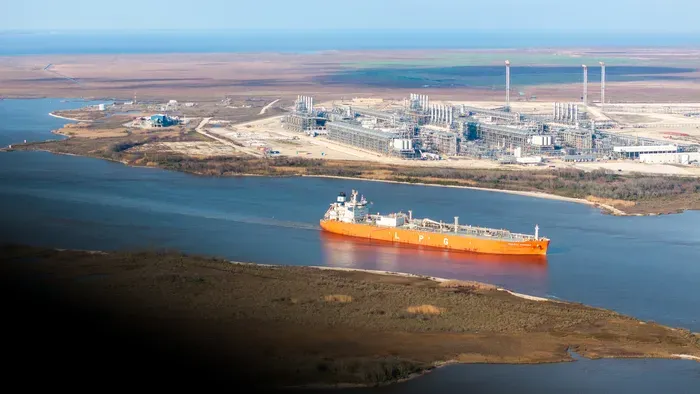
There are eight U.S. LNG export terminals, all on the Gulf of America and East Coast: four in Louisiana, two in Texas, and one each in Georgia and Maryland. A ninth—ExxonMobil’s Golden Pass on the Texas side of Sabine Pass—began liquifying natural gas in February and will begin shipping soon.
“Even when Golden Pass begins operations, the available domestic supply is sufficient to cover that volume without having a significant impact on natural gas price,” Medlock said.
Peter Hartley, a Baker Institute for Public Policy researcher specializing in the economic and regulatory impacts of LNG exports, said that infrastructure diversity will also determine which economies will be most damaged by the loss of Qatari LNG.
Nations without pipeline networks linked to natural gas fields—that instead invested billions in LNG import terminals that will be largely idle for the foreseeable future—will be most affected, he said.
“Anyone who is an importer is now feeling the pain in higher prices,” Hartley told The Epoch Times.
“But for countries that don’t import gas—and there are lots of them, the United States is one—the fallout will be less significant. That’s where LNG is different from oil, because the oil price finds its equilibrium globally.”
Qatar’s Bad Bet
Americans may not see higher natural gas prices, but the loss of Qatari LNG will make it more expensive to produce goods in East Asian manufacturing hubs, which will eventually manifest in higher costs for some consumer products, Hartley said.
“The supply shock is going to feed into widespread economic—I’ve used the word ‘pain’ already—slowdowns, and that’s going to feed back into the economy,” he said. “You get a sort of global recession that drags everything down. So that’s where the United States is going to be affected.”
There’s irony in Iran destroying Qatar LNG infrastructure, he said, since “the world had been transforming away from pipeline transport of natural gas into LNG as a result of problems in Europe, in particular Russia’s invasion of Ukraine,” making moving LNG by ship seem less vulnerable to sudden shocks.
“LNG was considered less risky politically because there are many more suppliers, and you can buy from other suppliers if something goes wrong with one,” said Hartley, who has toured Qatar’s LNG operations.
“Whereas, if you’re tied to one producer with a pipeline, and something goes wrong with the pipeline, that’s it. I mean, you’ve got no alternative.”
That compounds “the tragedy of what’s happening” with “the realization of how strategically fragile things really are,” Munton said, noting Qatar’s emergence from “an economic backwater” after Shell’s 1980s “world’s largest gas discovery” in its North Field made the tiny country “the king of LNG.”
“So you have this huge juxtaposition between a micro-economy and the largest gas field on the planet,” which put Qataris in an enviable but vulnerable position, he said.
“Qatar, first and foremost, thinks about one thing more than anything else, and that’s its own security because it’s a very small, indefensible country, and it needs the help of bigger powers.
“So it became Qatar’s security strategy to retain major international oil companies [and for those investors to] have economic interests deeply rooted into Qatar security.”
Global oil companies, such as ExxonMobil and Chevron, are invested in Qatar’s LNG industry. Chinese state-controlled firms CNPC and Sinopec each own 5 percent equity stakes in Qatar’s planned LNG expansions. Qatar’s foreign policy can be defined as “‘friends with everyone,’” he said.
“Qatar is hosting the U.S. Air Base at Al Udeid Air Base, but they’re also hosting international pariahs like the Taliban, like Hamas, and so forth. They stay close with Iran, and that’s the way you safeguard your security, right?” Munton said.
“So 30 years of strategic policy has come undone within two weeks,” he said.
“It goes beyond just the immediate crisis of their natural gas disruption and now attacks on their infrastructure; it goes to the essence of their security policy going forward. So the fallout from this will be felt in every conceivable way in Qatar.”