
By Autumn Spredemann
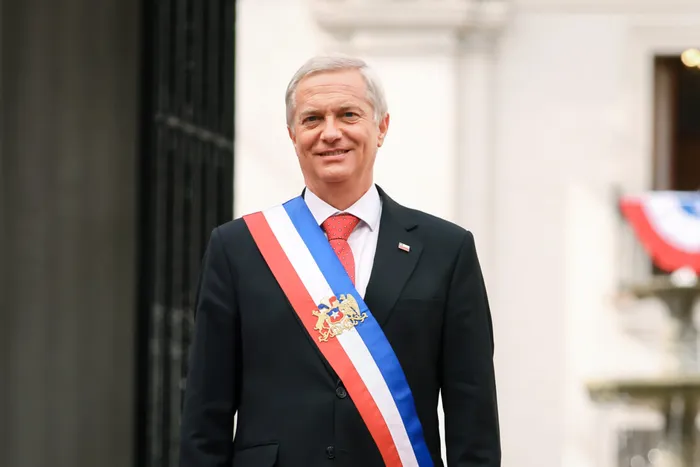
“We are going to take back our country,” newly minted Chilean President José Antonio Kast told a crowd of thousands as he took office March 11. Some say Kast’s leadership signals a shift in the country’s approach to economics and security, bolstering the new wave of conservative dynamism in the region.
During his first speech at La Moneda, the presidential palace in Santiago, Kast highlighted three main priorities for his administration: security, economic growth, and stemming the flow of illegal migration at the country’s northern border with Bolivia.
“They handed us a country in conditions worse than we imagined,” Kast said during his La Moneda speech. He emphasized that his administration is an “emergency government,” and vowed to get to work immediately.
Like Argentina, Paraguay, Ecuador, and Bolivia, Chile has pivoted toward right-wing leadership amid an influx of conservative politicians in the region who are more aligned with U.S. interests. Chile plays a vital role in global supply chains, particularly in essential minerals such as copper and lithium. Some analysts say Kast’s administration could influence trade, foreign investment, and Chile’s balance between partnerships with the United States and China.
One of the most affluent and stable countries in South America, Chile could significantly influence the regional shift toward right-wing leadership, analysts say.
“You need clear rules, and you need a serious president with a serious plan. Kast really sends those signals,” Latin America economist Corina Marion told The Epoch Times.
As a former Chilean resident, Marion said she was pleased to finally see a president taking the nation’s challenges seriously. She believes there will be new opportunities to expand foreign investment under Kast, but only if he “cleans up” the long-standing migration and crime troubles in the country’s north.
Chaos at the Border
“The northern border [with Bolivia] is a well-known contraband route and a corridor for illegal migration. It’s a route for money laundering, for bringing illegal drugs from Bolivia to the coast,” Marion said.
For years, Chile’s remote northern frontier has been problematic to patrol due to a lack of infrastructure and its remote high desert location. Attempts to control the flow of illegal migration and contraband under former President Gabriel Boric marked some progress around the border town of Colchane—an infamous immigration bottleneck known as the “corridor of death.”
But local investigators say the area remains a “breeding ground” for various crimes and a nexus for illegal immigration, cross-border trafficking, drugs, and illegal vehicles.
A surge in illegal immigration through this same corridor has also strained public resources and drawn concern from Chilean residents. The most recent official numbers state that as of 2023, there were 336,984 “undocumented” immigrants living in Chile, representing more than 17 percent of the total estimated foreign population. That number was just over 10,000 in 2018.
In a 2022 Latin American and Caribbean Economic System study of the population housed at the Colchane Temporary Migrant Center, more than 90 percent were Venezuelan. Most of this observed group arrived illegally, the report said.
Boosting Foreign Investment
This “chaotic” situation of illegal migration and narco trafficking has persisted for years at the Chile–Bolivia border, creating an increasing atmosphere of “uncertainty” for foreign investors, Marion said.
Organized and violent crime, including drug trafficking, have been a deterrent to increased foreign investment, according to an Atlantic Council analysis.
The same report noted that skepticism over potential policy changes between drastically different political regimes, stagnant economic growth, and regulatory delays have deterred some longer-term foreign investment.
Market changes and a rise in government regulations have been cited as additional hurdles to foreign investment, amid a gradual economic slowdown in Chile.
“This decline has mostly been driven by policy decisions that increased government regulation of markets. Greater regulation was mostly welcome, but there may have been areas—like the length of time required to obtain approval for investment projects—where the trend has gone too far,” an Atlantic Council report from 2024 reads.
To boost foreign investment, Kast has proposed public spending cuts, corporate tax reductions, and possibly eliminating the capital gains tax.
“As a result, companies should anticipate that investment oriented tax measures will move forward, but with gradual implementation shaped by political dynamics and fiscal limitations,” a Baker McKenzie analysis stated.
The U.S. Department of State recognizes Chile as an attractive destination for doing business, due to its overall economic prosperity and stability, but highlighted similar barriers to investment in a 2025 report.
“Permitting processes for infrastructure, mining, and energy projects are lengthy and outcomes are less predictable in cases involving politically sensitive environmental impact assessments, water rights issues, and indigenous consultations,” the analysis noted.
Marion said, “Chile is a very strong economy; they just need to prioritize security and incentives.”
The United States accounted for the largest share of Chile’s foreign investment projects in 2025, at $19.1 billion.
China’s Shadow
Some regional analysts say security cooperation with the United States is likely to increase under Kast.
At the same time, the new administration may adopt more of a “closed door” policy with China, said Evan Ellis, a Latin America research professor for the U.S. Army War College.
China is one of the South American nation’s top trading partners and the largest export market for Chile’s goods, encompassing more than 35 percent.
“The United States is our historic partner, but China is our main trading partner,” Patricio Navia, a professor of Latin American politics at New York University, told nonpartisan think tank Global Americans this month.
Navia said that while Washington is Chile’s key strategic partner, Beijing is still the country’s biggest buyer.
“Kast must reassure Washington that Chile remains a close ally, even as it conducts business with China,” Navia said. “At the same time, Santiago must show Beijing that it is a reliable commercial partner—though not one with the same deep, historic relationship it shares with the United States.”
Ellis said: “It remains to be seen how much can be done with China. It could change security-wise, but I have a hard time believing they’ll just stop selling things to China.”
Marion agrees with this sentiment. “Chile doesn’t live by political dogma. They are more sensible when it comes to foreign economic policy,” she said.
A Regional Struggle
The challenges Kast faces—Chinese influence, drug cartels, and mass immigration—are reflected across Latin America, Marion said.
“This is a fight for all Latin American nations that requires multinational cooperation,” she said. “It’s very important, in Chile, we see this change with Kast to create new economic opportunities.”
Striking a balance between the United States and China has become a tightrope walk for many new Latin American governments that inherited Beijing-dominant investment portfolios from previous regimes.
“It’s what we’re seeing across the region now, not just in Chile,” Ellis said.
President Donald Trump this month established the Shield of the Americas, a multinational security coalition, to acknowledge and address those shared regional concerns.
A few days before he took office, Kast attended the inaugural Shield of the Americas Summit in Doral, Florida, demonstrating an interest in deepening security cooperation with the United States.
Seventeen nations were represented at the March 7 gathering, including Argentina, Bolivia, Chile, Costa Rica, the Dominican Republic, Ecuador, and El Salvador. The leaders of left-leaning Mexico, Brazil, and Colombia did not attend.
The coalition aims to coordinate efforts to “stop foreign interference in our hemisphere, criminal and narco-terrorist gangs and cartels, and illegal and mass immigration,” the U.S. State Department said on its website prior to the summit.
Back in Chile, those aims are reflected in the “border shield” promise that helped Kast win the presidency. On March 16, work began on a planned border barrier along the country’s northern border with Peru.