
By Omid Ghoreishi
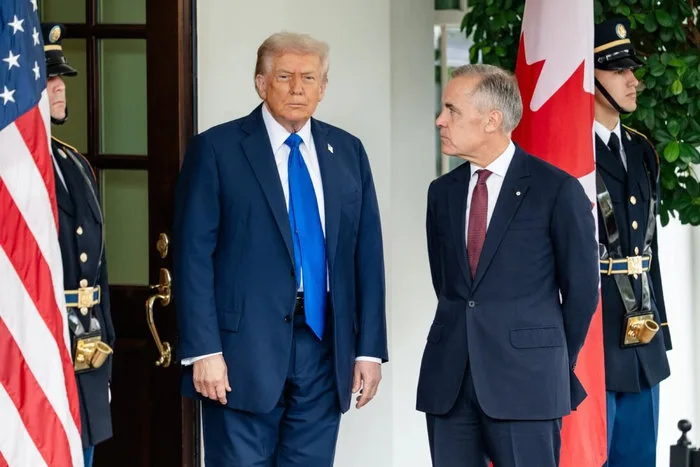
U.S. President Donald Trump says Canadian goods exported to the United States would be hit with 100 percent tariffs if Canada makes a deal with China.
“If Governor Carney thinks he is going to make Canada a ‘Drop Off Port’ for China to send goods and products into the United States, he is sorely mistaken. China will eat Canada alive, completely devour it, including the destruction of their businesses, social fabric, and general way of life,” Trump said in a post on Truth Social on the morning of Jan. 24.
“If Canada makes a deal with China, it will immediately be hit with a 100% Tariff against all Canadian goods and products coming into the U.S.A. Thank you for your attention to this matter!”
The U.S. president wrote the remarks while posting a Jan. 23 article by Just the News titled, “Deal with the Devil: How Canada’s New Partnership With China Could Backfire.”
In a subsequent post, Trump said, “The last thing the World needs is to have China take over Canada. It’s NOT going to happen, or even come close to happening!”
Trump’s reference to Canadian Prime Minister Mark Carney as “Governor” marks a return to the way he referred to Carney’s predecessor, former Prime Minister Justin Trudeau, using the title to reflect his view that Canada should be part of the United States. He had not previously used the title for Carney, saying on several occasions that he likes him. Relations soured, however, after Carney delivered a speech at the World Economic Forum (WEF) in Davos, Switzerland, on Jan. 20, in which he levelled criticism at the United States.
Prior to arriving in Davos, Carney met with Chinese leader Xi Jinping in Beijing, where he signed a series of agreements that included slashing tariffs on Chinese EV imports from 100 percent to 6.1 percent for the first 49,000 units, in exchange for China cutting tariffs on Canadian canola from 85 percent to 15 percent until at least the end of the year. While in Beijing, Carney said Canada–China relations are entering a “new era,” and that Ottawa’s pursuit of a partnership with China “sets us up well for the new world order.”
In a statement issued just past noon on Jan. 24, Carney’s minister responsible for trade with the United States, Dominic LeBlanc, stressed the importance of Canada-U.S. relations, adding that Ottawa is not pursuing a free trade deal with China.
“As the Prime Minister said this week, Canada and the United States have built a remarkable partnership in our economy and security — and we will remain focused on ensuring the future of that relationship will benefit workers and businesses on both sides of our border,” LeBlanc said.
“There is no pursuit of a free trade deal with China. What was achieved was resolution on several important tariff issues.”
Late on the morning of Jan. 24, Carney’s office shared a promotional video on social media about Carney’s recent trips to China and Qatar, and his attendance at the WEF, captioned, “From China to Qatar to #WEF26 in Davos, Prime Minister Carney advanced Canada’s economic and strategic interests – strengthening partnerships, diversifying trade, and attracting investment to support good jobs and long-term growth for Canadians.”
In another video shared by Carney later on Jan. 24, the Canadian prime minister said Canada’s economy is “under threat abroad,” encouraging Canadians to “buy Canadian, build Canadian.”
“You are choosing to put your hard-earned dollars behind Canadian businesses and Canadian workers. Canada’s new government is doing the same, with our new Buy Canadian Policy,” he said, referring to his government’s policy of prioritizing Canadian suppliers of materials such as steel and aluminum for government contracts. “We can’t control what other nations do. We can be our own best customer.”
Cutting Tariffs on China
Trump had initially shrugged off Carney’s new agreement with China, telling reporters on Jan. 16 that, “It’s a good thing for him to sign a trade deal. If he can get a deal with China, he should do that.”
But senior members of his cabinet were concerned. U.S. Transport Secretary Sean Duffy said Canada will regret the decision to partner with Beijing and allow Chinese EVs into its market. “I love my friends in Canada, but they will live to regret the day they let the Chinese Communist Party flood the market with their EVs!” Duffy said in a Jan. 17 post on X.
U.S. Trade Representative Jamieson Greer told CNBC on Jan. 16 that the agreement is “problematic for Canada,” and that Washington had imposed tariffs to protect autoworkers. He said that while Canada made the agreement to bring relief to agricultural producers, in the “long run, they’re not going to like having made that deal.”
Canada first imposed 100 percent tariffs on Chinese EVs, along with levies on steel and aluminum, in 2024, in lockstep with the United States, which has long been concerned about China dumping products.
Canada’s other agreements with China include memoranda of understanding on energy, public safety, and lumber.
Davos Speeches
In his speech at the WEF in Davos on Jan. 20, Carney criticized U.S. pressure to acquire Greenland, while saying middle powers should band together to resist pressure from major powers. “Great powers have begun using economic integration as weapons, tariffs as leverage, financial infrastructure as coercion, supply chains as vulnerabilities to be exploited,” he said. His speech was praised by some world leaders, including Finnish President Alexander Stubb and Mexican President Claudia Sheinbaum.
Trump said the next day in his speech at the WEF that Carney “wasn’t so grateful,” adding that Canada “lives because of the United States.”
Carney said in another speech on Jan. 22 in Quebec City, this time addressed to Canadians, that Canada “does not live because of the United States. Canada thrives because we are Canadian.”
Later that day, Trump said he is rescinding his invitation to Carney to join the U.S.-led Board of Peace that is going to help rebuild Gaza.
In another Truth Social post on Jan. 23, Trump criticized Ottawa’s position on Greenland and China, saying, “Canada is against The Golden Dome being built over Greenland, even though The Golden Dome would protect Canada. Instead, they voted in favor of doing business with China, who will ‘eat them up’ within the first year!” The Trump administration’s Golden Dome project aims to deploy a network of Earth- and space-based sensors and weapons to intercept cruise missiles, hypersonic missiles, ballistic missiles, and drones.
Meanwhile, Beijing’s envoy to Ottawa weighed in on the Greenland issue while taking a swipe at the United States, saying this week that Canada and China “see eye to eye” on supporting Greenland’s territorial integrity, according to The Canadian Press.
Trump’s Commerce Secretary Howard Lutnick also criticized Carney’s recent comments and agreement with China, suggesting that his recent remarks may be related to an upcoming election. He added that Ottawa’s EV deal with Beijing could jeopardize Canada’s chances when renegotiating the United States-Mexico-Canada Agreement (USMCA) later this year.
“You don’t want to be this favored neighbor because you’ve taken it so for granted that you’re willing to come to Davos and say, ’there’s two hegemonic powers in the world, and we’re going to decide which one we’re going to work with.’ Really? You’re going to either work with the United States of America, where 75 percent of your economy is totally tied to it, or China? Why would you say that?” Lutnick told Bloomberg on Jan. 22.
He added that Trump may not allow Canada to maintain the “second-best” trade deal with the United States when it comes time to renegotiate the USMCA, noting that Canada’s current deal with the United States ranks second after Mexico. Under the USMCA, 85 percent of Canadian goods are exempt from tariffs, while products that don’t comply with the trilateral deal face tariffs of 35 percent. Mexico’s non-USMCA products are subject to 25 percent tariffs.
Carney hasn’t appeared at media press conferences since relations with Trump soured this week, cancelling a scheduled press conference at the conclusion of a cabinet meeting in Quebec City on Jan. 23.
Finance Minister François-Philippe Champagne, who took questions from the press instead, said Carney couldn’t attend due to a “scheduling issue.”
Carney was asked by reporters about his talks with Trump late on Jan. 22 as he walked to a cabinet meeting. He responded, “Oh, that’s the most boring question. Think of a new one.”