
By Matthew Vadum
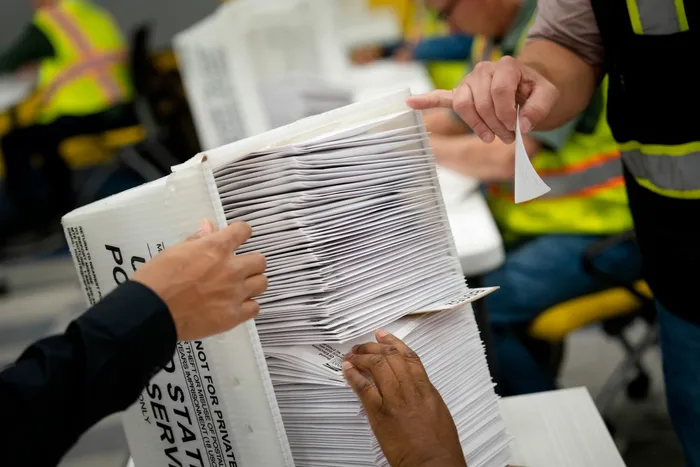
The U.S. Supreme Court on March 23 seemed skeptical of a Mississippi law that allows the state to count mail-in ballots received after Election Day in federal elections.
Mississippi law allows counting of mail-in ballots received within a five-day grace period after Election Day.
The law was enacted in July 2020 during the COVID-19 pandemic to provide flexibility to voters.
Eighteen states accept mailed ballots received after Election Day if they are postmarked on or before Election Day, according to the National Conference of State Legislatures.
Federal law sets the Tuesday after the first Monday in November in certain years as Election Day for federal offices.
A presidential election takes place every four years; a congressional election occurs every two years.
The Election Day law focuses on when ballots must be cast, as opposed to when they must be received by election officials to count.
In October 2024, the U.S. Court of Appeals for the Fifth Circuit held in the case that even though states have primary responsibility for regulating federal elections within their borders, Congress is also allowed to “make or alter such regulations.”
The circuit court held that the federal Election Day law preempts Mississippi law, preventing the state from accepting late ballots.
Mississippi argues that striking down its law will cause upheaval in those states that allow ballots received after Election Day to be counted.
The Republican National Committee (RNC), the state’s Republican Party, and the state’s Libertarian Party sued over the state law.
President Donald Trump issued an executive order a year ago to end the counting of ballots received after Election Day.
A federal court in Washington blocked part of the order in January.
During oral arguments on March 23, Justice Samuel Alito seemed concerned about the possibility of fraud when “a big stash of ballots” that arrives late “radically” flips an election.
Mississippi Solicitor General Scott Stewart replied, saying that the other side has not pointed to “a single example of fraud from post-Election Day ballot receipt in this century.”
Echoing concerns Trump raised in his executive order, Alito said the meaning of Election Day has expanded over the years.
“We’re moving in this direction,“ the justice said. ”We don’t have Election Day anymore. We have election month or we have election months.”
Justice Brett Kavanaugh asked RNC attorney Paul Clement whether Purcell v. Gonzalez (2006) would be implicated if the high court were to rule on the case by June.
Purcell held that federal courts ordinarily should not enjoin state election laws close to an election to avoid disruption.
Clement replied that a June ruling would allow “plenty of time” to adjust for the general elections.
Justice Sonia Sotomayor questioned Clement’s argument that late-arriving military and overseas ballots should not be counted.
“Maybe we need a new president,” Sotomayor said, noting that in the disputed 2000 election, military ballots that arrived late were counted and helped Republican candidate George W. Bush win the election.
Clement rejected the justice’s observation, saying that it was “the reddest of red herrings.”
Historical Considerations
Laws governing absentee military ballots have historically required that they be received by Election Day, Clement said.
Stewart said Congress has long allowed the late receipt of ballots.
The Mississippi solicitor general said Congress established the federal Election Day in 1845 when voting practices were different.
“If Election Day must be what it was in 1845, that takes out much more than the ballot receipt laws of 30 states today,“ he said. ”It dooms absentee voting, modern methods of voting, the secret ballot, and more.”
“Congress did not adopt that destabilizing view when it simply set the Election Day,” Stewart said.
Sotomayor told Stewart that the Mississippi law is “very consistent” with practice during the Civil War and with “what has happened for over a hundred years.”
Clement said the Congress of 1845 would have believed it “unthinkable” to count ballots following Election Day.
Justice Amy Coney Barrett asked whether the same principle would have led that 19th-century Congress to reject early voting.
“Why is that permissible?“ Barrett asked. ”If we’re just going to say that historically it needs to look like it always looked, how come those features fall out?”
After several justices questioned whether the RNC’s argument that ballots cannot be counted after Election Day also means that ballots cannot be counted before Election Day, the federal government’s attorney said it was not arguing against early voting.
“We agree with both sides that early voting is still acceptable,” U.S. Solicitor General D. John Sauer said.
Clement was correct when he said early voting has “a distinct historical pedigree,” Sauer said.
Chief Justice John Roberts told Sauer that his answer was not “responsive to the point that if the Election Day is the voting and taking, that has to be that day.”
Sauer replied, “It’s a challenging question.”
Justice Elena Kagan said reading too much into the federal Election Day statute is problematic.
“Once we go down this road, once we say that these statutes which don’t say anything actually have some significant preemptive effect, where are we going to end up?” she asked.
The Supreme Court is expected to issue a ruling on the case by the end of June.