
By Andrew Moran
The number of Americans filing applications for unemployment benefits remained historically low last week ahead of the April jobs report.
For the week ending May 2, initial jobless claims rose by 10,000 from the previous week to a seasonally adjusted 200,000, according to new Department of Labor data released on May 7. Economists had penciled in a reading of 205,000.
Last week’s figure—the lowest since 1969—was revised a tad higher to 190,000. The four-week average, which strips out week-to-week volatility, declined to 203,250.
Despite a wave of layoff announcements by major tech and non-tech firms this year amid the adoption of artificial intelligence (AI), jobless claims continue to hover around historical lows.
Others might be having an easier time finding employment opportunities.
Continuing jobless claims—a measure of individuals currently receiving unemployment benefits—dipped to a lower-than-expected 1.766 million. The previous week’s number was adjusted lower to 1.776 million.
Economists use this statistic to gauge, in part, the health of the U.S. labor market and the difficulty out-of-work Americans may face in finding jobs. Additionally, it could signal that people are exhausting their benefits, since many states limit eligibility to 26 weeks.
Over the past year, employment conditions have been described as “low-fire, low-hire.” While the latest data confirm the first half of that narrative, the April jobs report could determine whether the second half needs to change.
Sneak Peek at April Jobs Report
The Bureau of Labor Statistics will release the April nonfarm payrolls report on May 8.
The consensus forecast suggests the economy created 60,000 jobs—down from the better-than-expected 178,000 seen in March—and the unemployment rate held steady at 4.3 percent.
Average hourly wage earnings are also expected to rise 0.3 percent on the month and 3.8 percent year-over-year.
Current conditions indicate that a relevant description would be “high-functioning friction,” said Mark Hamrick, senior economic analyst at Bankrate.
“While the economy remains remarkably resilient, the prevailing sense is one of standing still amid volatility,” Hamrick said in a note emailed to The Epoch Times.
“Friday’s April report will reveal if the economy is withstanding mounting pressure of global supply chain shocks and associated inflation.”
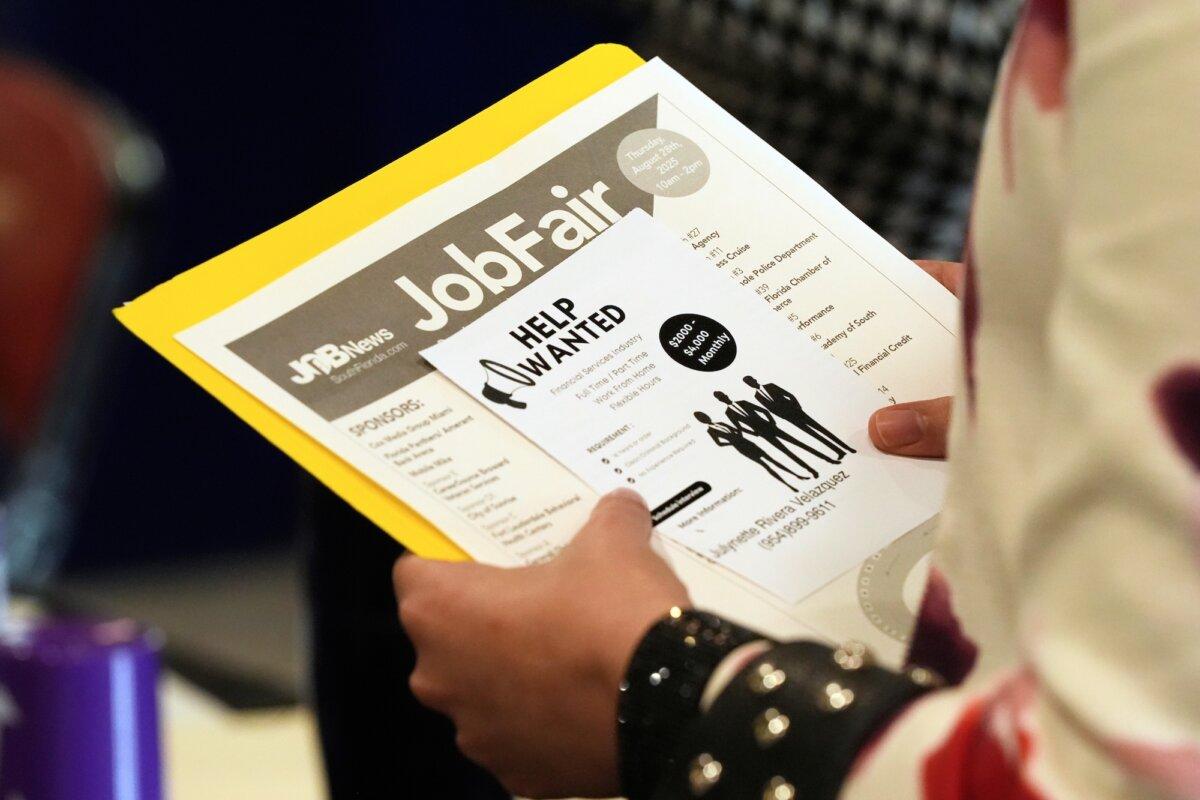
Like the broader economic landscape, the U.S. labor market has been resilient amid a range of headwinds, including the war in Iran and President Donald Trump’s tariff agenda.
Private employers added 109,000 jobs in April, according to payroll processor ADP. The number of new hires soared by 655,000 in March to 5.554 million, the bureau reported. Planned layoffs are down 21 percent from a year ago.
“Assuming the war de-escalates in coming weeks and months, the U.S. economy should enjoy a better year of job growth in 2026 than 2025,” Bill Adams, chief U.S. economist at Fifth Third Commercial Bank, said to The Epoch Times in an emailed note.
“If the war resolves relatively soon, other trends in the economy could easily push the unemployment rate lower by the end of this year.”
Several business surveys suggest that while activity is robust, they are contending with renewed price pressures. The longer the conflict drags on, and the higher energy prices are, the harder it will be for companies to maintain the momentum.
The industries that expanded payrolls in April will be another component that market watchers will observe.
Job creation, for the most part, has been concentrated in health care, with more than 400,000 new positions since March 2025.
This could remain the case for April, says Joseph Brusuelas, chief economist at RSM.
“Hiring in April will be similar to what has been the case for some time: Health care and education will be the primary driver of overall private sector hiring, leisure and hospitality will ease, and job creation elsewhere will be relatively restrained as government hiring remains weak and even declines,” Brusuelas said in a May 5 note.
The Long-Term Outlook
But the employment arena is also undergoing structural changes.
Immigration policy, lower labor force participation, and AI adoption are among the factors that will influence the labor market and data.
The labor force participation rate has been edging lower since late 2025, reaching a more than five-year low of 61.9 percent last month.
While tighter immigration policies have contributed to a stall in labor force growth, an aging native-born population and fewer young adults working have also been factors.
The share of Americans aged 55 and older who are working sits slightly above 37 percent, the lowest level since April 2005.
Additionally, there are fewer young people in the U.S. workforce: fewer young adults are working, and youth account for a smaller share of the population. While these numbers have sharply declined in recent years, they have been in a long-term downward trend since the 1990s.
These developments could overhaul labor dynamics, but they could also keep the unemployment rate low, say economists at the Dallas Federal Reserve.
Research published in March indicated that the breakeven rate—the level of new jobs needed to leave the jobless rate muted—is close to zero.
“The updated estimates show that continued net outflows of unauthorized immigrants, together with shifts in labor force participation, have pushed the monthly break-even employment growth lower than previously thought,” the economists wrote in the paper.
The breakeven peaked at approximately 250,000 in 2023, and declined to near zero after July 2025, “averaging about –3,000 jobs per month from August to December 2025.”

AI, meanwhile, is leading to mixed outlooks.
A large share of April’s planned layoffs was driven by artificial intelligence, according to global outplacement firm Challenger, Gray and Christmas. At the same time, economists point to Jevons’ paradox to argue that AI could complement the workforce rather than destroy jobs.
Nineteenth-century economist William Stanley Jevons stated that when technology enhances the efficiency of resources, demand for those resources will increase.
In an April 28 research note, Torsten Slok, chief economist at Apollo, says AI is creating a “Jevons employment effect.”
“When the cost of professional work falls, the addressable market expands, and the total number of firms and workers in the field grows,” Slok said in a note emailed to The Epoch Times.
“The bottom line is that cheaper inputs don’t shrink industries. Instead, AI is going to increase both productivity and employment.”
He pointed to recent examples of radiologists, call centers, and travel agents as examples where AI has bolstered employment.
This, he says, was evident in the 1990s, when Microsoft Excel substantially lowered the cost of financial analysis, record-keeping, and reporting, rather than decimating the need for professional accountants.