
By Tom Ozimek
Iran has signaled that it intends to exert lasting control over the Strait of Hormuz—the world’s most critical oil shipping lane—after the war, warning that no country will be allowed to transit without its permission as part of what it called a “new global order.”
The Iranian news website Nour News, affiliated with the Islamic Revolutionary Guard Corps (IRGC), on April 4 published a statement by a spokesman for the Iranian Parliament’s presidency under the headline: “The Strait of Hormuz Will Not Return to Its Former Status.”
The statement said the Strait of Hormuz, through which some 20 percent of the world’s seaborne oil transits, “has become a strategic advantage” under new security conditions and “will not revert to its former status.”
It added that “management of this important waterway is in the hands” of Iran’s armed forces and that “no country has the right to pass” without Tehran’s permission, and that Iran would defend the position “with all its military power.”
Tehran’s path is “neither compromise nor surrender,” the spokesman said, adding that Iran stands firm and plans to consolidate its position in what he described as a “new global order.”
The remarks suggest Iran intends to preserve its ability to choke off the strait beyond the current conflict—leveraging control over global energy flows as a source of long-term strategic pressure.
President Donald Trump has made restoring access a condition for a cease-fire, while urging allies and major energy importers to take a leading role in securing navigation through the corridor.
Secretary of State Marco Rubio said a postwar coalition, backed by the United States, would ensure the strait remains open.
“It will be open because Iran agrees to abide by international law and not block the commercial waterway, or a coalition of nations from around the world and the region, with the participation of the United States, will make sure that it’s open,” Rubio said in a March 30 interview with Al Jazeera. “But one way or the other, it’s going to be open.”
Rubio said in a separate interview that the Trump administration has a range of options to counter any continued Iranian restrictions or the imposition of transit fees, though he declined to specify measures.
“That’s not going to be allowed to happen,” Rubio said.
Trump, on April 3, suggested the United States could forcibly reopen the passage.
“With a little more time, we can easily open the Hormuz Strait, take the oil, & make a fortune. It would be a ‘gusher’ for the world???” Trump wrote in an April 3 post on Truth Social.
French President Emmanuel Macron said that a military effort to secure the strait would be complex and risky.
“It would take forever and would expose all those crossing the strait to risks” of Iranian attack, he said, adding that restoring access “can only be done in consultation with Iran.”
British Foreign Secretary Yvette Cooper said after a meeting of more than 40 countries seeking to address the disruption that Iran’s strategy is “to hold the global economy hostage.” The discussions focused on political and diplomatic measures, not military intervention.
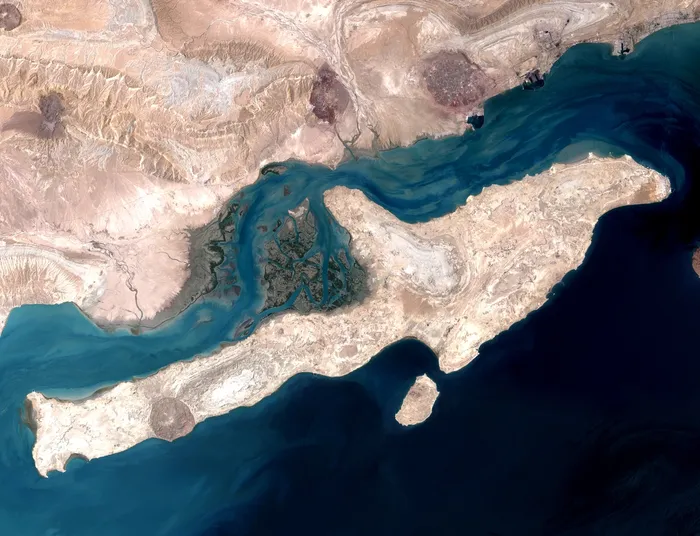
The strait, which separates Iran and Oman, is about 21 miles wide at its narrowest point, but shipping lanes in each direction are only about 2 miles wide, making vessels highly vulnerable.
Some analysts say Iran is unlikely to relinquish control even after the war, as it looks to rebuild. Imposing transit fees on commercial shipping could provide a source of revenue for reconstruction.
Former CIA Director Bill Burns said that Iran is likely to try to keep the leverage it has gained by disrupting maritime traffic.
Tehran will seek to use that leverage to secure “long-term deterrence and security guarantees” in any post-war settlement, as well as “direct material benefits” such as passage fees, he said in a Foreign Affairs podcast.
“That,” Burns said, “sets up a really difficult negotiation.”
Reuters contributed to this report.