
By T.J. Muscaro
Iran’s Revolutionary Guard said it has launched retaliatory attacks against multiple nearby U.S. military bases on Feb. 28 after it faced the first strike of what the United States is calling Operation Epic Fury.
The Guard said in a statement that it struck the U.S. Navy’s 5th Fleet Command in Bahrain, as well as U.S. bases in Qatar, Kuwait, and the United Arab Emirates (UAE).
U.S. Central Command (CENTCOM) later confirmed that Iran launched hundreds of missile and drone attacks in retaliation for the initial strike wave. It stated that the Iranian attacks were successfully defended against. No U.S. casualties or combat-related injuries were reported nearly 12 hours since the operation began, and damages to any U.S. installations were minimal with no operational impact, CENTCOM said.
The bases’ host countries announced they are taking actions to defend their borders from long-range missile strikes before they reach the American strongholds.
Here’s what we know so far.
US Navy’s 5th Fleet Headquarters, Bahrain
The Kingdom of Bahrain confirmed a missile strike targeted the U.S. Navy’s 5th Fleet headquarters located within its borders. That fleet is responsible for patrolling the Red Sea, the Persian Gulf, the Strait of Hormuz, the Gulf of Oman, and the Arabian Sea.
The U.S. Embassy in the capital city, Manama, issued a security threat warning of imminent missile and drone strikes less than two hours after Operation Epic Fury began.
“The U.S. Embassy in Manama urges U.S. citizens in Bahrain to shelter in place, review security plans in the event of an attack, and stay alert in case of additional future attacks,” the statement read. “U.S. Embassy personnel are sheltering in place.”
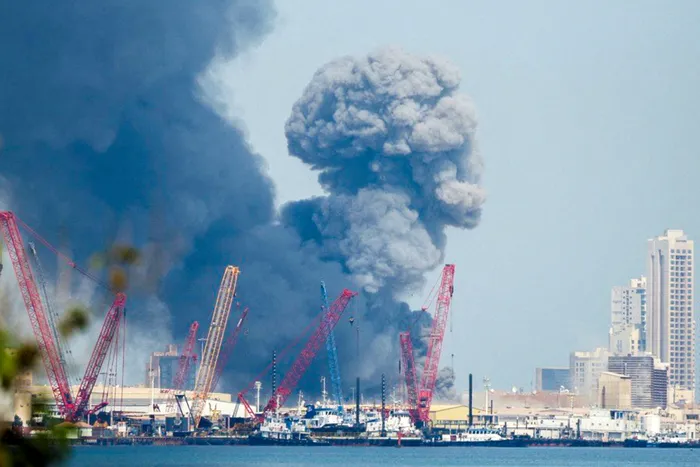
The Bahrain Ministry of Interior also told its people to shelter in place and began evacuating the Juffair area, a highly populated area of Manama near a Navy base.
Explosions and a tower of smoke were reported in the capital city as well.
Al Udeid Air Base, Qatar
The Al Udeid air base is roughly 20 miles outside of Doha, Qatar. Al Udeid has served as a major hub of U.S. military activity in the Middle East, hosting as many as 10,000 troops during the height of the conflicts in Iraq and Afghanistan.
It previously faced retaliatory attacks from Iran after the United States launched precision strikes on Iran’s nuclear facilities in 2025.
No confirmation of an attack has come from the United States, but Qatar stated that it was repelling multiple missile strikes within its territory.
“Qatari Armed Forces possess full capabilities and resources to safeguard the nation’s security and to firmly confront any external threat,” the Qatari Ministry of Defense said in a statement.
Qatar’s interior ministry said on social media that no damage had been reported.
Ali Al Salem Air Base, Kuwait
The Ali Al Salem Air Base is one of several U.S. military installations in Kuwait, positioned 25 miles from the Iraqi border. Its host country confirmed it was targeted by a missile strike.
“Ali Al-Salem Air Base came under attack by a number of ballistic missiles,” Colonel Staff Saud Abdulaziz Al-Otaibi, official spokesperson for the Kuwait Ministry of Defense, said in a statement. “This morning, the Kuwaiti Air Defense Force successfully intercepted them, resulting in fragments and debris from the interception operation falling in the vicinity of the base.”
The country is also home to Camp Arifjan, the forward headquarters of U.S. Army Central.
Al Dhafra Air Base, United Arab Emirates
Al Dhafra Air Base is located south of the UAE’s capital, Abu Dhabi. It is a critical hub of the U.S. Air Force that is shared with the UAE Air Force, and has played a role in missions against ISIS and reconnaissance missions across the region.
The UAE is also home to Dubai’s Jebel Ali Port, which regularly hosts U.S. Navy aircraft carriers and other vessels.
While it gave no confirmation of whether or not Al Dhafra or Jebel Ali was specifically targeted, the UAE Ministry of Defense announced in a statement on social media that it had successfully intercepted multiple waves of Iranian missile and drone strikes since the conflict began.
The UAE’s Ministry of Defense revealed that 137 Iranian ballistic missiles were detected to be launched at the country, as well as 209 Iranian drones. Of those missiles, 132 of those were destroyed, with the other five falling into the sea, and 195 of the drones were intercepted. The remaining 14 drones fell within the UAE’s territory and waters, “causing some collateral damage.”
The ministry previously shared that falling weaponry resulted in the death of one person of Asian nationality in the first wave.
Trump Warns of American Casualties
President Donald Trump said the strikes against Iran’s regime could result in American casualties.
“The lives of courageous American heroes may be lost, and we may have casualties,” he said in a statement on the operation on Feb. 28.
“That often happens in war. But we’re doing this not for now. We’re doing this for the future.
“We pray for every service member as they selflessly risk their lives to ensure that Americans and our children will never be threatened by a nuclear-armed Iran,” he said. Reuters and The Associated Press contributed to this report.