

By Chris Summers
Iran said on April 9 that the Strait of Hormuz is open to all civilian shipping but has warned vessels to coordinate with Tehran, due to the risk from mines in the channel.
Deputy Foreign Minister Saeed Khatibzadeh told ITV in an interview, broadcast on April 9, that ships from all countries—including the United States—can pass “as usual” if they liaise with Iranian authorities.
Khatibzadeh said the need for coordination is tied to safety concerns, including mines laid during the conflict.
“Those technical restrictions are very much connected to the wartime condition, and it takes time to be removed,” Khatibzadeh said, adding that each vessel should make “necessary arrangements” with the Iranian authorities to be able to pass through the strait safely.
‘Possible Anti-Ship Mines’ Warning
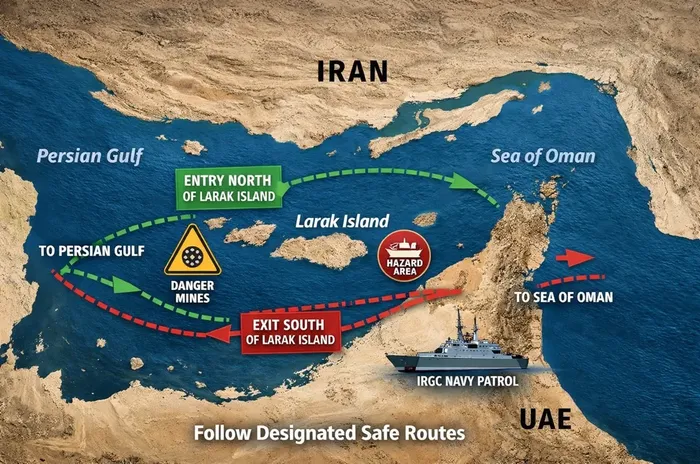
In a post on X on April 9, the Iranian Consulate in Mumbai warned of “possible anti-ship mines” and shared a map showing a mined area in the main channel of the strait.
It encouraged ships to take two alternative corridors further north, one of which is what became known as the “tollbooth” lane, north of Larak Island.
Oil hovered near $98 a barrel on April 9, as traffic through the strait remained well below peacetime levels.
Tehran closed the strait after U.S. and Israeli strikes began in Iran on Feb. 28, triggering a severe disruption to global energy markets.
The 21-mile-wide passage carries roughly 20 percent of the world’s seaborne oil supply—approximately 20 million barrels per day.
Earlier this week, Trump had threatened to obliterate Iran’s energy sector and infrastructure as a retaliatory measure against the Tehran regime’s targeting of shipping in the strait.
Reopening the strait was a key condition of the two-week ceasefire, which was announced on April 7.
But there have been disagreements between the United States and Iran as to whether Lebanon—where Israel has continued to strike at Hezbollah targets, an Iranian proxy—was included in the ceasefire.
On April 8, White House press secretary Karoline Leavitt said reports that the strait was closed were false.
Iran’s semi-official Fars news agency had reported that Tehran halted oil tanker traffic through the strategic waterway in response to Israeli airstrikes in Lebanon.
Leavitt said what the Iranians were saying publicly was different to the facts on the ground, and she said Washington had observed increased movement through the passage.
In a post on X on April 9, the speaker of the Iranian parliament, Mohammad Bagher Ghalibaf, wrote, “Lebanon and the entire Resistance Axis, as Iran’s allies, form an inseparable part of the ceasefire.
The so-called Axis of Resistance includes Hezbollah, Hamas, the Houthis in Yemen, and various pro-Iranian militias in Iraq.
France Finalizing Escort System
French Foreign Minister Jean-Noël Barrot said France is finalizing plans with around 14 other European nations to escort ships through the strait.
“Planning for this mission is currently being finalized between French military officials and countries that have volunteered,” Barrot told France Inter radio.
He said work was well advanced for an escort system, “once calm has been fully restored.”
It is not clear whether he meant the escort system would begin before the end of the two-week ceasefire.
British Foreign Secretary Yvette Cooper is due to give a speech at the Mansion House in London on the evening of April 9, and an advance copy has been released.
“The fundamental freedoms of the seas must not be unilaterally withdrawn or sold off to individual bidders,” Cooper is expected to say, according to the advance copy. “Nor can there be any place for tolls on an international waterway. Freedom of navigation means navigation must be free.”
Reuters contributed to this report.