

By Ryan Morgan
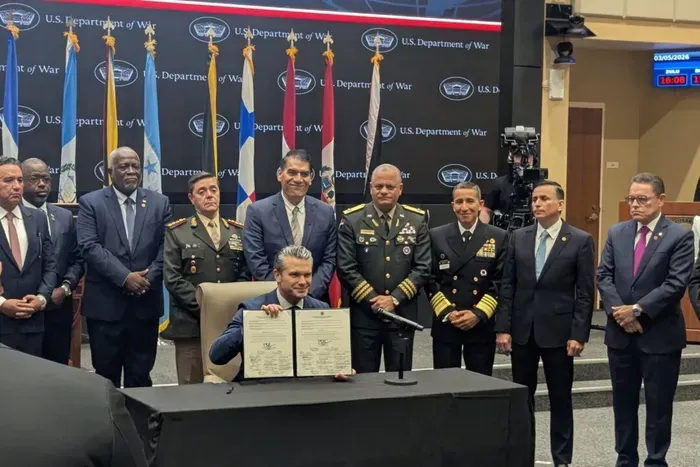
DORAL, Florida.—U.S. Secretary of War Pete Hegseth joined military officials from across Latin America and the Caribbean in signing a joint security declaration on March 5, amid a push to boost military partnerships in the Western Hemisphere.
Hegseth signed the joint declaration during the Americas Counter Cartel Conference, at the headquarters of the U.S. Southern Command (SOUTHCOM) in Doral, Florida.
Addressing the gathering of security officials from Central and South America, Hegseth said that while the Western Hemisphere is home to about an eighth of the global population, it’s responsible for about a third of its violent crime.
“There’s a reason for that. America’s retreat from protecting its citizens, and the complacency of many neighbors in this hemisphere, was a great betrayal,” he said.
Hegseth said President Donald Trump’s leadership would mark an end to that trend.
Trump’s latest national security strategy calls for increased U.S. military focus on the Western Hemisphere, adopting a so-called “Trump Corollary” to the Monroe Doctrine of 1823. Over the years, the Monroe Doctrine has formed the premise for the United States to treat the Americas as its sphere of influence.
The Trump administration’s renewed emphasis on Western Hemisphere security has seen increased U.S. military involvement at the U.S. southern border. Under his administration, U.S. forces have also conducted lethal strikes on suspected drug boats transiting the East Pacific and the Caribbean Sea, as well as the Jan. 3 operation to capture wanted Venezuelan leader Nicolás Maduro.
Hegseth said narcotics traffickers have become increasingly dissuaded by the campaign of U.S. strikes on suspected drug boats, which began in September of last year. Since the start of the campaign, known as Operation Southern Spear, U.S. forces have struck at least 44 vessels in the waters of the East Pacific and the Caribbean.
U.S. forces have assisted other nations in the Western Hemisphere in recent actions targeting cartels and other transnational criminal organizations in the region.
Mexican government forces carried out a heavily armed raid on Feb. 22 against Nemesio Rubén Oseguera Cervantes—also known as “El Mencho”—whom authorities considered the leader of the Jalisco New Generation cartel (CJNG). The United States provided intelligence in support of the raid, which ended in Oseguera Cervantes’s death and spurred an outburst of cartel violence throughout Mexico.
This week, SOUTHCOM announced U.S. and Ecuadorian forces had conducted joint operations against unspecified “designated terrorist organizations” in Ecuador. A Pentagon official told The Epoch Times the joint effort has not involved U.S. forces in combat.
“America is prepared to take on these threats and go on the offense alone, if necessary,” Hegseth told the gathered Latin American security leaders on Thursday. “However, it is our preference, and it is the goal of this conference, that in the interest of this neighborhood, we all do it together with you.”
At the Thursday conference, deputy White House chief of staff Stephen Miller also called on regional partners to forcefully pursue cartels and other transnational criminal organizations in the region.
“The cartels that operate in this hemisphere are the ISIS and the al-Qaeda of the Western Hemisphere and should be treated just as brutally and just as ruthlessly as we treat those organizations,” Miller said.
Miller said such organizations cannot be dealt with as a purely criminal justice matter.
“There are elements of the problem that require a criminal justice solution to be sure,” Miller said. “But … the reason why this is a conference with military leadership and not a conference of lawyers is because these organizations can only be defeated with military power.”
Related posts:
 DOJ Issues Directive Ending Biden-Era Task Force Aimed at Seizing Assets of Russian Oligarchs
 Nearly 50 Members of Congress Call on Pentagon to End Military Vaccine Mandate
 US Readiness ‘At Some Risk’ as Pentagon Sends $300 Million to Ukraine: Defense Official
 What to Know About the Insurrection Act of 1807