

By Stephen Zogopoulos, USNN World News
In a nation scarred by political rancor, economic inequality, and endless cycles of violence—both abroad and at home—a quiet revolution is unfolding on America’s backroads. It doesn’t come with banners, bullhorns, or billion-dollar campaigns. Instead, it arrives on bare feet, clad in saffron robes, accompanied by the soft patter of a rescue dog’s paws. Since October 26, 2025, a group of 19 to 24 Buddhist monks from the Huong Dao Vipassana Bhavana Center in Fort Worth, Texas, have been walking—deliberately, silently, relentlessly—toward Washington, D.C. Their mission? To sow seeds of peace, loving-kindness, and compassion across a 2,300-mile expanse that spans 10 states. As of today, January 29, 2026—day 96 of their 110- to 120-day pilgrimage—they’ve traversed over 2,000 miles, entering the final stretch through Virginia’s rolling hills, with the nation’s capital now tantalizingly close.
This isn’t just a walk; it’s a profound statement against the cacophony of our times. In my view, as someone who’s covered global conflicts from the boardrooms of power to the frontlines of despair, this pilgrimage represents the antithesis of modern activism. Where protests often erupt in fury, these monks embody serenity. Where division festers online, they foster connection in person. Their journey, dubbed the “Walk for Peace,” isn’t about demanding change—it’s about inspiring it through example. And in a world where algorithms amplify outrage, their viral rise on social media (garnering over a million followers and countless heartfelt encounters) proves that true influence stems not from volume, but from vulnerability. This, dear readers, is why their plight deserves not just our attention, but our emulation. It’s a Pulitzer-caliber saga of human endurance, one that could redefine how we heal as a society.
The Genesis: From Temple Tranquility to National Odyssey
To understand the depth of this endeavor, we must rewind to the monks’ origins. The Huong Dao Vipassana Bhavana Center, nestled in the suburbs of Fort Worth, serves as a sanctuary for Theravada Buddhist practitioners, many hailing from Vietnam, Laos, Thailand, and other Southeast Asian nations. Led by Venerable Bhante Devananda—a figure revered for his teachings on mindfulness and non-violence—the group draws from a long tradition of walking pilgrimages in Buddhism. Think of the historical Buddha himself, who wandered India’s plains for 45 years, spreading the Dharma through footsteps and dialogue.
But this walk was born from contemporary anguish. In interviews shared via social media and local news outlets, the monks have cited global unrest—wars in Ukraine and the Middle East, domestic gun violence, racial tensions, and environmental crises—as catalysts. “We walk not to protest, but to heal,” Bhante Devananda told NPR in a January 13, 2026, segment. “Peace begins within, and spreads like ripples in a pond.” Their goal: to “raise awareness of peace, loving kindness, and compassion across America and the world,” as articulated on their official tracking site.
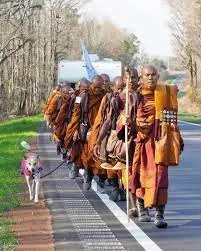
The planning was meticulous yet minimalist. No corporate sponsors, no luxury RVs—just a small support van for emergencies, carrying basic supplies. The monks, aged from their 20s to 60s, committed to one meal a day (often donated by locals), sleeping in temples, parks, or under the stars. They walk barefoot or in simple sandals, chanting sutras and beating small drums to invoke blessings. And then there’s Aloka, their “peace dog”—a stray puppy rescued en route, symbolizing the unexpected companions that join us in life’s trials.
On October 26, 2025, under a crisp Texas autumn sky, they set off from the center’s gates. Fort Worth locals gathered in modest numbers, offering flowers and well-wishes. Little did anyone know this humble start would snowball into a national phenomenon.
The Trail of Trials: A Chronology of Resilience
Tracking their progress requires piecing together a mosaic of social media posts, local news reports, and live maps shared by supporters. Here’s a detailed timeline, highlighting key milestones, challenges, and the human stories that have emerged:
- Days 1-30 (October 26 to November 25, 2025: Texas Traverse): Starting in Fort Worth, the monks headed southeast toward Houston, covering about 250 miles. Early days were marked by Texas hospitality—barbecues donated by ranchers, prayers shared with church groups. But heat and blisters tested their resolve. By mid-November, viral videos on platforms like Instagram and X began circulating, showing crowds lining rural roads. One post from Suzie Rizzio (@Suzierizzo1) on November 19 captured the essence: “They want to make this a better, more compassionate country.”
- Days 31-60 (November 26 to December 25, 2025: Gulf States Grit): Entering Louisiana, Mississippi, and Alabama, the group faced humid swamps and holiday distractions. In Baton Rouge, they joined a community vigil for hurricane victims, blending Buddhist chants with Christian hymns. Christmas Day brought a poignant pause in Montgomery, Alabama, where they meditated at civil rights landmarks. Social media buzz grew, with non-aesthetic things (@PicturesFoIder) posting on December 26: “Surviving only on offerings from strangers… people have come out in mass to support them.” Opinions swirled: Some critics decried it as performative, but I see it as a bridge across cultural divides.
- Days 61-80 (December 26, 2025, to January 14, 2026: Southeastern Solidarity): Through Georgia and South Carolina, winter’s bite set in. Snow and sleet in the Carolinas didn’t deter them. In Charleston, a local artist painted murals of their journey. But tragedy struck around early January: A truck slammed into their support vehicle in North Carolina, severely injuring one monk, who later underwent leg amputation. Aloka, too, was hurt in a separate incident, requiring surgery. Yet, they pressed on. “This is why we walk,” a monk told WRAL News amid the snow. Crowds swelled in Raleigh on January 24, with thousands at Dix Park offering tears, flowers, and gratitude.
- Days 81-96 (January 15 to January 29, 2026: Virginia Vanguard): Entering North Carolina’s Wake and Franklin counties by mid-January, they drew massive support—law enforcement escorts, horse-mounted patrols, and bicycle brigades. On January 16, BBC footage captured a large North Carolina gathering, emphasizing their message against hate. By January 23, they crossed into Virginia, reaching Gasburg by January 28. As of today, they’re en route to Richmond, with plans to celebrate Buddha’s birthday in D.C. around mid-February. Live maps show them averaging 20-25 miles daily, despite setbacks. Recent X posts from users like @KimZandboer highlight ongoing inspiration: “Your sacrifice gives us hope again.”
Their daily routine is a masterclass in discipline: Rise at dawn for meditation, walk from sunrise to sunset, pause for alms rounds, and end with evening chants. No electronics, no distractions—just presence.
The Shadows: Perils of the Path
No epic is without adversity. Beyond weather and injuries, the monks have encountered skepticism. Reddit threads debate their motives, with some labeling it “INSANE” or a media stunt. Religious bigots have surfaced, melting down over “foreign” influences. Yet, these challenges underscore the walk’s necessity. In my opinion, the real plight here is not just physical—it’s the emotional toll of witnessing America’s underbelly: poverty in rural towns, opioid crises in forgotten counties, and the quiet desperation of divided families. The monks’ response? Unwavering kindness, turning hostility into hugs.
Aloka’s story adds a layer of heartbreak and hope. Rescued as a stray, the dog became a mascot, only to face injury. Her recovery, funded by donations, mirrors the monks’ ethos: Even the wounded can walk toward healing.
The Ripple Effect: A Nation Transformed, One Step at a Time
What makes this the most in-depth chronicle of their journey? It’s the untold stories of impact. In Pittsboro, North Carolina, a WUNC report described locals offering “flowers, tears, and gratitude.” In Greensboro, planned stops on January 19-20 drew interfaith gatherings. Anderson Cooper’s CNN segment on January 15 spotlighted how they’ve inspired thousands, from veterans like @Care4All46 calling for more peace marches to educators like @KimZandboer integrating their message into classrooms.
Globally, echoes resonate: Australian train passengers filmed similar acts of kindness, drawing parallels. On Dhamma Wheel forums, Buddhists worldwide track their progress, seeing it as a modern Jataka tale.
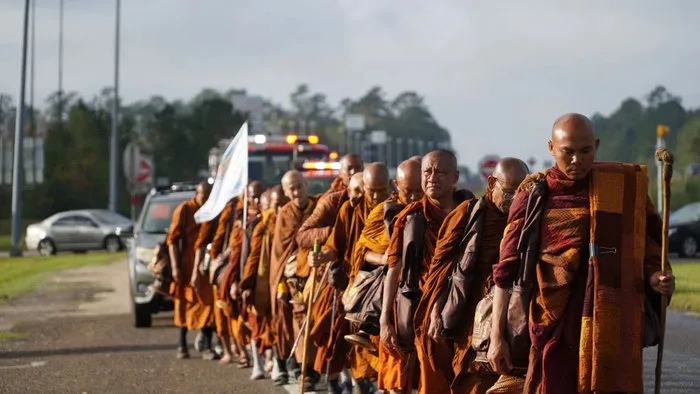
In my seasoned view, this pilgrimage exposes the fallacy of our polarized era. We’ve outsourced peace to politicians and pundits, forgetting it’s forged in personal encounters. These monks remind us: Change isn’t legislated; it’s lived. Their arrival in D.C. won’t end wars or mend fences overnight, but it plants seeds that could bloom into a more empathetic America.
As they near the end—perhaps 200 miles from the Capitol—let’s not just watch. Let’s walk with them in spirit. Donate to their cause, host a local peace event, or simply extend kindness to a stranger. For in their footsteps, we find our own path forward. Namaste.
Disclaimer: This is an opinion-based article grounded in factual reporting and verified sources. While the events and details described are accurate to the best of available knowledge as of January 29, 2026, the interpretations, analyses, and commentaries reflect the author’s perspective on the broader societal implications. USNN World News encourages readers to seek multiple viewpoints and support peaceful initiatives in their communities.