
By Andrew Moran
The Federal Reserve hit the brakes on its easing cycle and left interest rates unchanged in the central bank’s first policy decision of the year.
Officials voted 10–2 to keep the benchmark federal funds rate—a key policy rate that influences borrowing costs for businesses and consumers—in a range of 3.5 percent to 3.75 percent.
In a post-meeting statement, officials said uncertainty about the economic outlook remained elevated.
“Job gains have remained low, and the unemployment rate has shown some signs of stabilization. Inflation remains somewhat elevated,” the Federal Open Market Committee stated.
Additionally, the latest statement removed a portion that noted a higher risk of a weakening labor market than rising inflation. This could signal that officials could adopt a wait-and-see approach to crafting monetary policy to achieve its dual mandate of maximum employment and price stability.
“In considering the extent and timing of additional adjustments to the target range for the federal funds rate, the Committee will carefully assess incoming data, the evolving outlook, and the balance of risks,” it stated.
Stephen Miran and Christopher Waller—both appointed by President Donald Trump to the Federal Reserve Board of Governors—were the lone dissenters. They voted against holding policy steady and instead advocated a quarter-point cut.
Miran was selected to temporarily fill a seat on the Board of Governors in September 2025. His term expires on Jan. 31, and it is unclear whether he will be reappointed to the role.
Waller has been interviewed to be the next head of the Federal Reserve, although prediction markets suggest that he is a longshot.
The widely expected decision was the first time since the summer that the Fed did not make a move on rates.
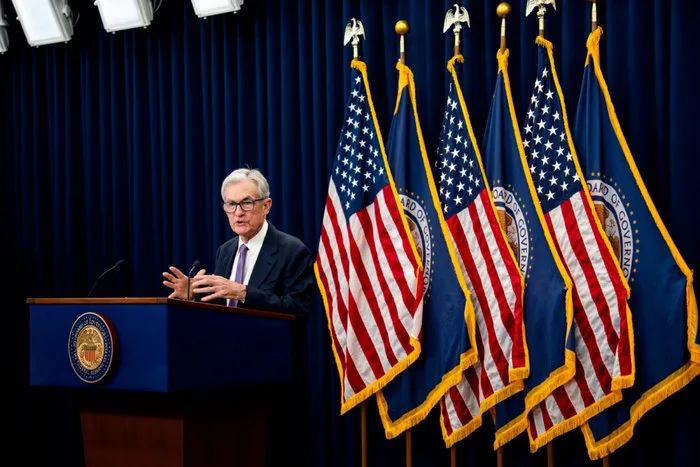
In his post-meeting news conference, Federal Reserve Chair Jerome Powell suggested that the central bank can loosen policy once prices ease.
Powell said he expects the pass-through effects on tariffs will peak, “and then [start] to come down, assuming there are no new major tariff increases that are begun.”
“And that’s what we expect to see over the course of this year. If we see that, that would be something that tells us that we can loosen policy,” he said.
Market Reaction
U.S. stocks were little changed following the policy action, with the leading benchmark averages seesawing between positive and negative territory.
Yields on U.S. Treasury securities were green across the board.
The benchmark 10-year and 30-year yields each picked up 4 basis points to firm above 4.26 percent and 4.87 percent, respectively.
The 2-year, which tends to track Fed policy expectations, rose to 3.59 percent.
The U.S. Dollar Index, a gauge of the greenback against a basket of currencies, surged by 0.5 percent. The index has been under tremendous pressure this week, adding to its year-to-date decline of about 1.5 percent.
“With minor but consequential changes to its statement, the Federal Reserve met the nearly universal expectation for a pause in the rate-cutting cycle. Economic conditions have stabilized enough for the Fed to take its foot off the gas, at least temporarily,” Stephen Kates, financial analyst at Bankrate, said in a statement to The Epoch Times.
“The updated language in the statement points to a more balanced economic picture.”
Springtime for Rate Cuts
The Federal Reserve and financial markets have different expectations for policy over the coming months.
Based on the Summary of Economic Projections—a quarterly survey of officials’ forecasts for interest rates and the economy—the Fed is projected to make a single quarter-point rate cut. The median benchmark policy rate is anticipated to finish 2026 at 3.4 percent.
Investors, however, think that the Fed will follow through on two to three quarter-point rate actions this year. The futures market is pointing to the June meeting as the next time that the central bank will agree to a reduction, according to CME FedWatch Tool data.
The timing is interesting because Powell’s term finishes in May.
According to Christian Hoffmann, head of fixed income at Thornburg Investment Management, it is unlikely that there will be sizable policy changes in the remaining days of Powell at the helm.
Instead, he said, all of the action will take place in the second half of the year.
“This is a very boring Fed meeting during very interesting times,” Hoffmann said in a note emailed to The Epoch Times.
“In my view, it’s really all the things going around in the background that are more interesting.
“Powell is overseeing just three more meetings, and we’re not likely to see any change in short-term rates for the remainder of his tenure.”
In a surprising turn of events, prediction markets suggest that BlackRock executive Rick Rieder is the heavy favorite to become the next head of the Federal Reserve System.
Polymarket data show Rieder with a more than 40 percent chance of securing the nomination. This is followed by former Board of Governors member Kevin Warsh (28 percent) and of current member Waller (10 percent).
Still, until then, market watchers say monetary policymakers will remain data dependent at a time when the labor market is stuck in a low-fire, low-hire climate and inflation remains elevated.
The next two-day policy meeting is scheduled for March 17 and March 18. Officials will have ample time to digest two job reports, key inflation data, and fourth-quarter gross domestic product figures.
“Fed rate cuts this year will depend on the data and the economic backdrop, which changes every single day,” Hoffmann said. “Looking at the playing field today, two to three rate cuts seems very reasonable, but the picture and the backdrop can evolve very quickly if policy actually swings in one notable direction or the other.”