
By Cynthia Cai
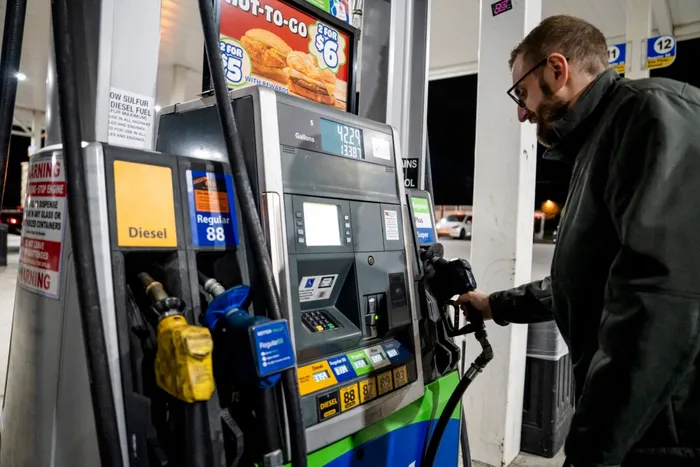
California’s gas prices are currently the highest in the nation as state and federal lawmakers consider bills in response to the costs at the pump.
Rep. Kevin Kiley (R-Calif.) announced plans to introduce legislation to push for lower gas prices by withholding certain federal funding from states that impose high gas taxes.
The Golden State currently has the highest gas taxes in the country. Drivers pay, on average, $0.91 per gallon in taxes and fees at the pump, which includes a $0.61 per gallon state excise tax, a $0.18 per gallon federal excise tax, a $0.10 per gallon sales tax, and a $0.02 per gallon underground storage tank fee, according to an estimated price breakdown from the California Energy Commission.
Under the proposal, states that have a gas tax of over 50 cents per gallon would see an 8 percent decrease in funding from the National Highway Performance Program (NHPP) and the Surface Transportation Block Grant Program (STBG).
The NHPP provides financial support to states for the construction and maintenance of roads within the National Highway System. Similarly, the STBG program provides funding to states and localities to maintain and improve public roads, including highways, bridges, and tunnel projects.
Kiley’s office told The Epoch Times that staff are working on the bill and hope to introduce it to the House “sooner rather than later.”
“This bill sends a clear message: states that overtax their citizens to compensate for inefficient spending should not expect unlimited federal support,” said Kiley in a Feb. 10 press release. “If Sacramento wants Washington’s help, it should stop punishing drivers.”
Gov. Gavin Newsom’s office stated in June 2025 that his state’s fuel prices are a result of a “legislatively mandated and voter-approved gas tax increase.” In 2018, voters rejected Proposition 6, which would have required voter approval before imposing, increasing, or extending any gas taxes or vehicle fees. Currently, fee and tax changes are passed by lawmakers and require the governor’s signature.
California’s gas prices are also affected by a number of environmental regulations. Prices at the pump include, on average, $0.14 per gallon that goes toward the Low Carbon Fuel Standard (LCFS) and $0.24 that stems from the state’s cap-and-trade program, which is aimed at reducing greenhouse gas emissions.
The state government, however, says on its website that “LCFS regulations do not automatically raise prices at the pump,” instead accusing oil companies of shifting “the cost of complying with the LCFS regulation to consumers.”
During the summer, California drivers also pay for a special summer-blend gas that evaporates at a higher temperature than regular winter-blend gas. This blend is “less likely to contribute to unhealthy ozone and smog levels,” according to the California Energy Commission. Summer-blend fuel, however, is “more expensive to produce,” it stated. Other areas of the nation also use summer-blend gas, but California uses it for a relatively long period due to its warmer climate.
Kiley’s proposed bill aims to encourage states to decrease these fees and taxes.
“The legislation is intended to encourage fiscal responsibility at the state level while ensuring that federal transportation dollars are not used to subsidize excessive taxation policies that drive up the cost of living,” the press release states.
Meanwhile, in late 2025, Newsom signed into law legislation approving E15 fuel, a new blend of gas that “diversifies the state fuel supply” and helps drive down prices at the pump.
Proposal to Study Mileage Fee
Kiley’s proposal comes as California state lawmakers are considering a bill to require a study of a potential mileage fee.
Assembly Bill 1421 would require the California Transportation Commission to study and report on replacing the state’s gas tax with a “road user charge or a mileage-based fee system” for all drivers.
AB 1421 is now in the state Senate after passing the state Assembly in late January 2026.
The bill would not implement new tax or fee changes, but focuses on research.
Lawmakers said California drivers are increasingly choosing electric vehicles (EVs) over gas-powered cars. This is expected to create a $31 billion funding shortfall over the next 10 years due to decreasing gas tax revenues, according to a Jan. 23 Assembly Floor bill analysis.
The analysis states that “lower-income individuals tend to drive older, less fuel-efficient vehicles,” whereas “higher income persons have purchased a disproportionate share” of zero-emission vehicles. Bill author Assembly Member Lori Wilson said AB 1421 would allow the state to find solutions that are “fair, affordable, transparent, and built to last.”
State Republicans, however, criticized the proposed study, saying that a mileage-based fee could risk “double taxation for California drivers” if the study eventually recommends the idea without removing the existing gas tax, according to the California Assembly Republican Caucus.
Newsom has also rejected the idea of a mileage tax. His office said in a post on X that “the Governor would not sign one.”
As lawmakers weigh legislation, a Bay Area-based fuel supplier has begun a phased shutdown of its Benicia refinery ahead of its original schedule. The refinery was originally slated to cease operation in April 2026.
Valero announced in April 2025 that it would close its refinery operations due to a strict regulatory environment and operational losses.
The company said it will use existing inventories and imported products to continue serving the Golden State’s fuel needs.
The Benicia refinery is located on the Carquinez Strait of San Francisco Bay. It had a throughput capacity of around 170,000 barrels per day and employed over 400 people.
Valero’s move comes after Phillips 66 began idling operations at its Los Angeles refineries late last year. Phillips 66 said in October 2025 that it is committed to meeting fuel demand “by sourcing gasoline from within and outside its refining network.”