

By Louis Navellier
We’re approaching another earnings season, starting in mid-April, when many of our stocks shine the brightest. Some of the fundamentally superior stocks in our portfolio may bend, but they do not often break due to their strong underlying forecasted sales and earnings growth, so in a market like this, where it’s every stock for itself, we seek out fundamentally superior stocks – those likely to pop during earnings season.
One example is Argan (AGX), which surged 37.9% on March 27, a day when the Dow lost 793 points. Argan announced quarterly sales up 12.7% in the latest quarter. Better yet, earnings rose 56.3% to $49.2 million ($3.47 per share). Analysts expected sales of $255.3 million and earnings of $1.98 per share, so Argan posted a 2.7% sales surprise and a stunning 75.3% earnings surprise. Also, since Argan is a data center-related stock, it helped lift other data center stocks, which continue to exhibit relative strength.
Gold is also gaining back some of its glitter, so the 20+ gold stocks I recommend in many portfolios rose impressively last week. Forecasted sales and earnings for gold stocks in our portfolio remain strong, so I anticipate holding these gold stocks for at least several more months, as gold is a leading global “crisis hedge.”
In the last reporting season, S&P 500 earnings rose at a 14.1% annual pace. For the first quarter of 2026, the analyst community currently estimates S&P 500 earnings will rise another 14%. Clearly, there is no “earnings recession,” as any positive earnings surprises could boost earnings growth well above 14%.
Here are the most important developments recently and what they mean:
– In our podcast, Navellier Market Buzz, our guest, Eric Fry, a veteran investment strategist, and I discussed whether controlling world energy markets was part of the Trump Administration’s “master plan.” The U.S. is already controlling LNG shipments, so crude oil would logically be the next step to stabilizing energy prices for the world. Due to the shipping woes through the Strait of Hormuz, crude oil and LNG prices remain high, so the first step to getting energy prices down is to get this key shipping route reopened.
– The Institute of Supply Management (ISM) announced that its non-manufacturing, service index slipped to 54 in March, down from a robust 56.1 in February. Any reading over 50 signals an expansion, so this is still a positive signal that the service sector is healthy. The culprits behind the decline in the ISM service index were the employment component, which declined to 45.2 in March, down from 51.8 in February, plus the business activity component, which declined to 53.9 in March, down from 59.9 in February. Overall, 13 of the 16 service industries that ISM surveyed reported an expansion in March.
– The Commerce Department announced on Tuesday that durable goods orders declined 1.4% in February, which was significantly lower than economists’ consensus expectation of a 1.1% decline. Transportation orders declined 5.4% in February due to a 37% decline in Boeing’s commercial aircraft orders. It will be interesting to see if Boeing’s orders will pick up after the Iran war is concluded. Excluding transportation, durable goods orders actually rose 0.8% in February, which was higher than economists’ consensus estimate of a 0.5% increase. As a result, there were some green shoots in the February durable goods report.
– There will be a GDP update and a Consumer Price Index (CPI) announcement this week. I will be poring over the GDP details and looking for green shoots of potentially sustainable GDP acceleration from productivity gains, as well as the benefits of a shrinking trade deficit. As far as the CPI is concerned, it is supposed to be hideous, due to recent food and energy inflation, but if the core CPI (excluding food and energy) does not rise more than 0.3%, that would be considered a positive development.
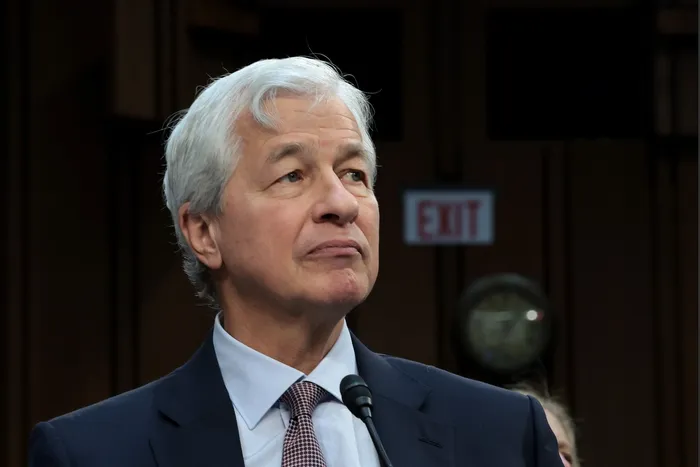
– In the meantime, if you like to worry, all you have to do is read JP Morgan CEO Jamie Dimon’s annual letter. Specifically, Dimon talked about “The skunk at the party—and it could happen in 2026—would be inflation slowly going up, as opposed to slowly going down,” and then added, “This alone could cause interest rates to rise and asset prices to drop.” So, despite the fact that Kevin Warsh is the incoming Fed Chairman, Jamie Dimon is providing interest rate guidance.
– Frankly, Jamie Dimon is more influential than current Fed Chairman Jerome Powell, so it is imperative that incoming Fed Chairman Kevin Warsh asserts himself and dominates the headlines after his Senate confirmation. In the meantime, there is a lot of confusion regarding the course of interest rates due to (1) a recent lackluster Treasury refinancing, (2) growing federal budget deficit concerns, and (3) surging food and energy prices. In the interim, it would be good if Treasury Secretary Scott Bessent could install some confidence in Treasury markets until he can hand the baton to Kevin Warsh.
Overall, despite the fears of an inflation spike and the uncertainty regarding an Iranian ceasefire, Wall Street is rallying due to wave after wave of positive analyst earnings revisions. The relative strength and institutional buying pressure that was obvious during quarter-end window dressing has carried over to this week. I think it is fair to say that the excitement about the upcoming quarterly announcement season is building, so we have a lot to look forward to in the upcoming weeks.