
By Chase Smith
Several Democrats with possible 2028 presidential ambitions used this past week’s Munich Security Conference to build foreign policy credentials and counter President Donald Trump and his administration’s approach to U.S. alliances, with some of them presenting concrete policy proposals.
California Gov. Gavin Newsom, Michigan Gov. Gretchen Whitmer, Arizona Sens. Mark Kelly and Ruben Gallego, Connecticut Sen. Chris Murphy, Rep. Alexandria Ocasio-Cortez (N.Y.), and former Commerce Secretary Gina Raimondo were among the Democratic officials attending the Feb. 13–15 conference in Munich.
Newsom signed a formal memorandum of understanding with Oleksandr Kulepin, deputy governor of Lviv Oblast, Ukraine, on Feb. 14, alongside California Business and Economic Development Director Dee Dee Myers.
Story continues below advertisement
The agreement is aimed at strengthening trade and commercial ties between California and the region—which has sister-state status with California—and supports sustainable reconstruction and economic development in healthcare, energy, agriculture, defense, infrastructure, and emerging technologies.
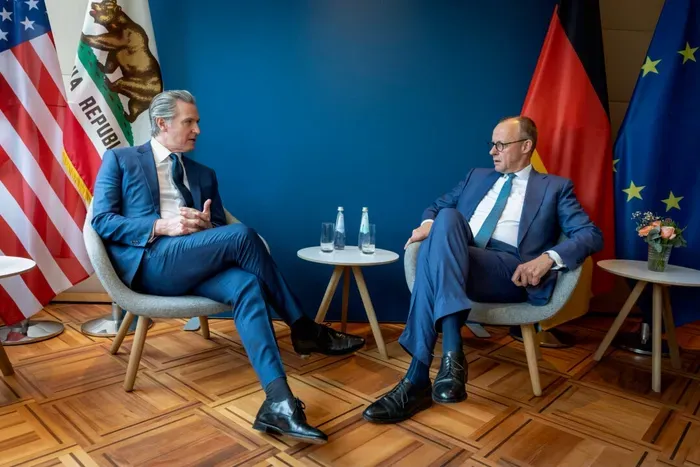
Newsom also had meetings with German Chancellor Friedrich Merz and Spanish Prime Minister Pedro Sánchez on the conference’s sidelines, focusing on climate action, economic opportunity, and democratic values, according to his office. He framed California’s Munich presence in explicit contrast to that of the federal government.
“Donald Trump is temporary, he’ll be gone in three years,” Newsom said during a conference panel. “California is a stable and reliable partner in this space. And it’s important for folks to understand the temporary nature of this current administration in relationship to the issue of climate change and climate policy.”
Whitmer also traveled to Munich with policy documents in hand, announcing the release of Michigan’s Defense and Aerospace Strategic Plan—a five-year roadmap for Michigan’s defense, aerospace, maritime, and space sectors.
The plan was developed by the Office of Defense and Aerospace Innovation within the Michigan Economic Development Corporation, the governor’s office said.
“Michigan has always stepped up when our nation needed us most,” Whitmer said in a statement. “Our Defense and Aerospace Strategic Plan ensures Michigan is ready to lead again, by growing our economy, strengthening our supply chains, and supporting the men and women in uniform who defend our country.”
Whitmer had earlier visited RENK Group’s German headquarters, where the propulsion and drive-train technology manufacturer announced plans to expand in Michigan and create roughly 300 jobs, her office said.
Murphy addressed a conference panel on Gaza, calling the humanitarian situation there “morally unacceptable” and accusing the current administration of having “engaged in a consistent campaign to alienate our friends in Europe.”
Murphy said the administration must use leverage with Israel to ensure that the next phase of the Gaza plan is implemented.
“I really worry about the long-term health of the U.S.-Israel relationship if we don’t see real, meaningful progress in the clearing of rubble, in the delivery of humanitarian and medical aid, the construction of actual, real permanent shelters in which people can live,” he said.
“This is going to be critical for the United States to continue to build support for the ultimate, very expensive reconstruction project.”
Kelly departed Munich on Sunday with a pointed assessment posted to X.
“It took a World War and eight decades to build the strongest alliance that this world had ever seen,” Kelly wrote. “It took less than a year to practically destroy it.”
Kelly said the damage, in his opinion, was apparent across more than a dozen meetings he held with presidents, prime ministers, and defense and foreign ministers during the conference. He said the United States is now less popular than China in many EU countries.
“Make no mistake, China is rising,” Kelly wrote. “I know there was celebration at the end of the Munich Security Conference. Unfortunately, the champagne corks were popping in Beijing and Moscow.”
The Democratic senators also used the conference sidelines for substantive diplomacy, joining a bipartisan meeting with Bosnia and Herzegovina officials alongside Sen. Roger Wicker (R-Miss.) to address secessionist activity threatening the Dayton Peace Agreement, which ended the Bosnian War in 1995.
Secretary of State Marco Rubio represented the administration at the conference, seeking to reassure European allies that Washington had not abandoned transatlantic relationships.
“Under President Trump, the United States of America will once again take on the task of renewal and restoration, driven by a vision of a future as proud, as sovereign, and as vital as our civilization’s past,” Rubio said.
“And while we are prepared, if necessary, to do this alone, it is our preference, and it is our hope to do this together with you, our friends here in Europe, for the United States and Europe—we belong together.”
He also acknowledged that both the United States and Europe had made “mistakes” in the post-Cold War decades and that it was now time to correct them together.
Tom Ozimek contributed to this report.