

By Terri Wu
China has set its lowest economic growth target in decades for this year, at 4.5 to 5 percent.
Beijing has maintained its target at “around 5 percent” for the past three consecutive years, and last year reported a growth rate of exactly 5.0 percent—no more and no less.
The regime has long projected a bright economic outlook by overstating its economic data, said Yeh Yao-yuan, a professor of international studies at the University of St. Thomas in Houston. Yet if Beijing continued to claim the same 5 percent growth rate this year, Yeh said, it could have come across as a “cruel irony” to the people. Amid the collapsing property market and shrinking export sector, ordinary Chinese citizens have felt the deterioration of economic conditions.
At the same time, the regime cannot allow the growth target to fall too low, as that could trigger fears of an economic crisis.
In Yeh’s view, “manipulation of people’s expectations and mentality”—while still preserving the regime’s face—ultimately led Beijing to settle on the current range.
While meeting the annual growth target is a “political assignment” that involves massaging statistics, the departure from the 5-percent benchmark is significant, according to William Lee, chief economist at consultancy Global Economic Advisors.
Breaking the streak, Lee said, amounts to the “biggest admission of failure” on behalf of the Chinese regime.
“They realize that anything even close to 5 percent would be absurd. Their model of growth is starting to show strain,” he told The Epoch Times. “Their dependence on export-led growth without the U.S. market is a huge vulnerability.”
Despite a planned summit between U.S. President Donald Trump and Chinese leader Xi Jinping—now postponed—the outlook for China’s exports remains increasingly uncertain.
A Masked Export Story
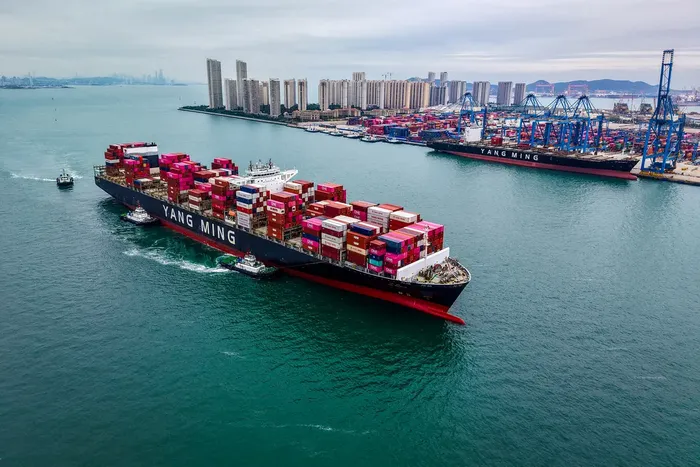
Exports have remained one of the few bright spots in China. The Rhodium Group estimated that external trade accounted for more than half of last year’s increase in China’s total economic output. The company expects exports to pull the same weight in China’s 2026 economic outlook.
In addition, Rhodium estimates that the world’s second-largest economy actually grew at about half of the official rate in 2025 and has been below 3 percent since 2022.
On paper, China appeared to begin this year with robust exports, up nearly 22 percent year-on-year, far exceeding analysts’ expectations of 7 percent.
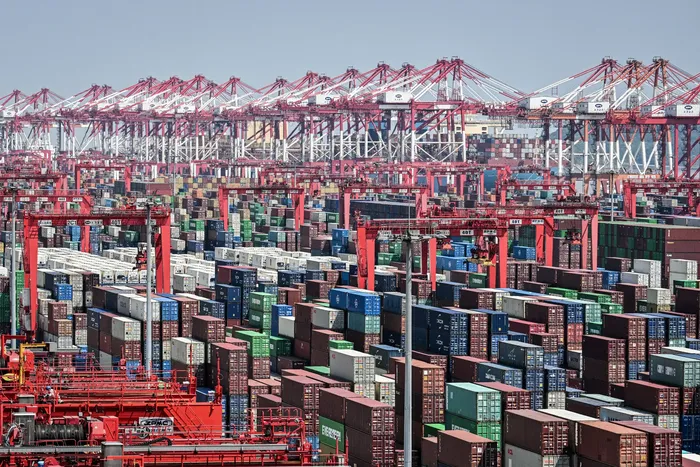
Stronger exports to Southeast Asian and European Union countries helped offset the double-digit drop in goods flow to the United States. The year-on-year export growth to the two regions was nearly 30 percent for the first two months of 2026. As a result, China’s trade surplus surged to more than $200 billion, marking a 25 percent increase from a year earlier.
But some analysts say that the numbers may be misleading.
Lee described China’s official export data as “artificial,” interpreting the surge as inventory building for transshipment rather than final sales. In other words, those goods may have crossed China’s borders but are still in transit, looking for end buyers.
In principle, a country’s exports should match its trading partners’ imports, a comparison often referred to as mirror trade. In practice, small discrepancies are common because exports are recorded differently from imports. These factors typically account for a gap of about 5 percent to 10 percent, according to the United Nations and the Organisation for Economic Cooperation and Development. Differences larger than about 15 percent may signal misreporting or transshipment through third countries.
Other economic indicators also cast doubt on the strength of China’s export sector.
China’s factory activity index, or purchasing managers’ index, has largely shown contraction since April 2025, suggesting weakening factory activity.
Cai Shenkun, an independent Chinese writer and commentator, said local governments have an additional incentive to inflate export figures.
The Chinese central government offers an export tax rebate. That cumulative rebate was over 2 trillion yuan, or about $280 billion, last year, according to global economic data provider CEIC. That’s slightly more than 7 percent of the value of China’s total exports.
Cai said that local governments often resort to tax rebates on exports during the holidays to cover extra expenses and then adjust their exports later in the year. The 2026 Chinese New Year fell in February, potentially amplifying such distortions.
Last year, reimports, or goods that were previously exported and then returned to China, totaled $126 billion, according to Global Trade Tracker. In contrast, U.S. imports of goods from China last year totaled about $300 billion.
Cai also noted another factor that could make export numbers easier to inflate.
In many cases, the importers of those goods are subsidiaries of Chinese enterprises based in Southeast Asia and Europe. Therefore, the quantity of exports to report becomes an internal decision under the same parent companies, he said.
Beijing hasn’t shown any sign of slowing down exports. The 2026 Government Work Report discussed maintaining the volume of foreign trade and improving the product mix.
Meanwhile, Washington has kept up its fences to curb Beijing’s dumping of overcapacity.
After the Supreme Court struck down the tariffs Trump imposed under the International Emergency Economic Powers Act, the president imposed a 10 percent universal tariff under Section 122 of the Trade Act of 1974, with plans to increase the levy to 15 percent.
The law allows the U.S. president to implement tariffs of up to 15 percent for up to 150 days without a full trade investigation.
Trump–Xi Summit Unlikely to Shift Outlook
The pressure on China’s export sector is unlikely to ease soon—even with the upcoming meeting between Trump and Xi.
The White House initially confirmed that Trump would visit China from March 31 to April 2, before the president announced he was postponing the trip for “a month or so” because of the war in Iran. Beijing has framed the visit as “heads-of-state diplomacy” and emphasized that Xi invited Trump because of Trump’s “desire to visit China.”
For Yeh, however, the broader trajectory of U.S.–China competition remains largely unchanged. The rivalry, he said, has entered an “irreversible” phase, driven by competition in trade, investment, and technology.
Several structural tensions remain unresolved.
The one-year pause on China’s stringent control on rare earths is due to expire in November. At the same time, the existing dual-use export control regime, including a 2024 prohibition on exporting certain dual-use items to U.S. military end users, remains in effect.
Meanwhile, Washington appears prepared to maintain pressure.
On March 11, U.S. Trade Representative Jamieson Greer announced a series of investigations into structural excess capacity in manufacturing sectors across a group of countries, including China, the European Union, and Southeast Asian countries.
The investigations are expected to conclude before the Section 122 tariffs expire in July, potentially setting the stage for further trade measures.
According to Yeh, a key issue is whether China is willing to provide a reciprocal investment environment for U.S. companies.
“If China is willing to open up on that front, then a summit might be meaningful,” he told The Epoch Times. “Otherwise, the Feb. 4 Trump–Xi phone call was already enough to reassure the world that the competition between the two countries will not escalate into a kinetic conflict.”
On Feb. 4, Trump said he and Xi had a “long and thorough call” discussing subjects including Iran, Taiwan, and the Russia–Ukraine. The president wrote in a Truth Social post that the discussion was “very positive,” and he described his relationship with Xi as “extremely good.”
“We both realize how important it is to keep it that way,” Trump wrote.
Domestic Pressures Raise Stakes for Xi
Xi also faces mounting challenges at home.
Recently, he purged Zhang Youxia, a vice chairman of the Central Military Commission and effectively the second-highest-ranking military leader in China. Zhang is the highest-ranking military figure ever removed in Xi’s sweeping anti-corruption campaign, which has targeted more than 100 senior officials since 2022, according to the Washington-based think tank Center for Strategic and International Studies.
In Cai’s view, Xi needs to stabilize the internal Chinese communist system. At the same time, Xi is widely expected to seek another five-year term as leader of the Chinese Communist Party, making political consolidation ahead of next year particularly important.
Against this backdrop, Cai added, a gesture of goodwill from the United States—long seen by Beijing as a crucial external support for China’s economic growth—would be highly valuable for Xi.
Sources in Beijing told Cai that Xi may be willing to offer concessions, such as placing a large order for Boeing aircraft or announcing major Chinese investments in the United States.
Another possible concession, Cai added, could be granting medical parole to Hong Kong media tycoon Jimmy Lai.
Lai, 78, was convicted under Beijing’s national security law late last year and sentenced to 20 years in prison. Trump has personally urged Xi to release him.
Whether such gestures materialize or not, analysts say Beijing’s lower growth target reflects mounting economic pressure extending from weakening exports to persistent trade tensions with the United States.
Related posts:
 Unveiling the Hidden Agenda: Did Russia Invade Ukraine for Rare Earth Minerals and Valuables?
 On the Brink of World War III: Examining Potential Triggers and the Role of the United States
 The Puppet Masters of World War III: Biden Administration’s Escalation and the President-Elect’s Efforts to De-escalate Global Tensions
 30 Ways Trump Impacted the US, World in First Year