

By Alex Wu
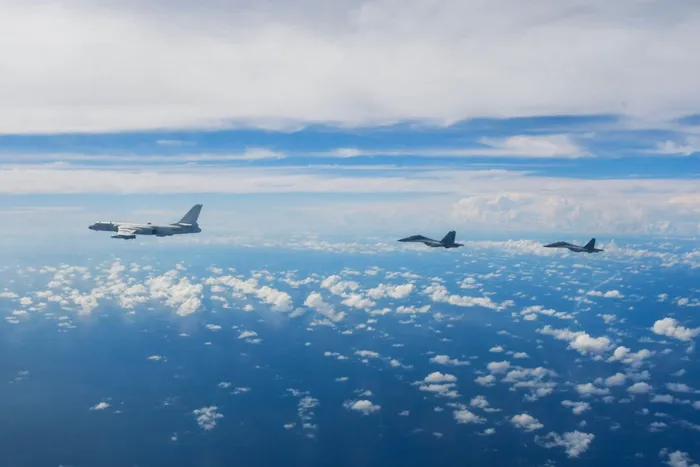
The Chinese communist regime has not flown military aircraft around Taiwan for over a week while the United States wages war against Iran.
This also comes as the ruling Chinese Communist Party (CCP) has held its annual top political meetings known as the Two Sessions, and CCP leader Xi Jinping is preparing to meet U.S. President Donald Trump in Beijing on April 1.
Analysts have told The Epoch Times that the CCP’s rare halt of its almost-daily air force activities to intimidate Taiwan has various geopolitical and economic reasons, given the current international situation.
According to Taiwan’s Ministry of National Defense, Chinese military aircraft have not appeared in Taiwan’s Air Defense Identification Zone (ADIZ) for eight consecutive days from Feb. 27 to March 6.
This comes as the United States and Israel launched a military strike against the Iranian regime on Feb. 28, killing Iran’s leader, Ayatollah Ali Khamenei. In the days that followed, the U.S.-Israeli forces made rapid progress in the war, destroying more than 60 percent of Iran’s missile launchers and rendering 80 percent of its air defense systems ineffective, said Israel Defense Forces Chief of Staff Lt. Gen. Eyal Zamir, according to an Israel Defense Forces statement. Trump said on March 7 that U.S. forces “knocked out” 42 Iranian navy ships in three days, wiping out almost all of Iran’s naval power.
Taiwanese lawmaker Lin Chun-hsien posted on Facebook on March 5, noting that the situation in Iran is rapidly changing, forcing the CCP to enter a period of strategic contraction and to comprehensively adjust its confrontation strategy with the United States. Consequently, he said, the means of exerting pressure in the Taiwan Strait also need to be reassessed.
Chen Wen-Chia, vice president of Kainan University in Taiwan and a defense strategy expert, told The Epoch Times that the halt of the Chinese military air force’s activities at this time is a tactical adjustment by the CCP under multiple factors, including military, diplomatic, and international situations.
China buys a large portion of Iran’s oil; it bought more than 80 percent of Iran’s shipped oil in 2025. China’s crude oil imports reached a record-high of 11.6 million barrels per day (bpd) in 2025, according to a January study by the Center on Global Energy Policy. Of that, Iran is estimated to have provided 1.38 million bpd or about 12 percent.
The disruption to Persian Gulf oil supplies to China due to the current conflict has a moderate impact on China. Sanctioned light crude from Iran traded at a significant discount to unsanctioned oil, as much as $8 to $10 a barrel below ICE Brent, so the disruption is removing a large portion of the discounted oil that China buys.
Chen said that in this context, Xi is about to meet with Trump in Beijing.
“It is not uncommon for the CCP to temporarily reduce its military activities towards Taiwan during diplomatically sensitive periods,“ he said. ”Furthermore, the CCP usually temporarily de-escalates tensions before important international talks or summits, to maintain negotiating space and a relatively stable international image. Therefore, the temporary reduction in military aircraft activity should be seen as an adjustment in diplomatic maneuver.”
US Deterrence
The U.S. strikes against the Iranian regime, which have taken out its top leader, have reduced an ally of the CCP in the Middle East, while Chinese-supplied air defense systems provided to Venezuela and Iran have been rendered ineffective by the U.S. military’s operations, causing concerns in Beijing, according to the analysts.
The Chinese regime knows that its own military capabilities are currently insufficient to defeat the United States, so it would not rashly launch a military invasion of Taiwan, Shen Ming-shih, research fellow at the Division of National Security Research at Taiwan’s Institute for National Defense and Security Research, told The Epoch Times.
“Trump has repeatedly warned Xi Jinping not to use force against Taiwan. I think within Trump’s second term, which ends in 2028, the CCP will not rashly invade Taiwan by force,” he said.
Recent speeches by spokespersons for the Chinese regime’s Taiwan Affairs Office have focused on the advocacy for reunification, peaceful reunification, or the use of united front tactics, Shen noted. “This reflected China’s Premier Li Qiang’s work report on Taiwan during the Two Sessions. However, the CCP’s fundamental policy towards Taiwan has not changed, which is anti-independence and pro-reunification.”
From a military operations perspective, Chen said that the Chinese military’s air force and navy activities around Taiwan have become highly routine in recent years. “Long-term, high-intensity deployments inevitably require maintenance, replenishment, and training rotations to maintain overall combat capability,” he said. “Therefore, it can’t be ruled out that the CCP is preparing for the next phase of military operations during the halt, and larger-scale joint exercises are likely to follow,” Chen warned.
Taiwan’s Ministry of Defense reported on March 7 that two Chinese military PLA auxiliary aircraft had been detected intruding into the southwest airspace of Taiwan, and six PLA navy ships had also spotted near Taiwan.
Pei Zhen, Luo Ya, and Reuters contributed to this report.
Related posts:
 Rubio Responds to Macron’s Call to ‘Break Away’ From US After China Meeting
 Russia Will Help China Advance Submarine Technology, US Indo-Pacific Commander Says
 US Must Do More to Replenish Munitions Stockpiles, Says White House’s Sullivan
 Democrats Roll out a Desperate Strategy to Deflect Blame for Their Failures