
By Naveen Athrappully
California Attorney General Rob Bonta has filed a lawsuit against two companies and more than 100 individuals, accusing them of unlawfully distributing computer code used for 3D-printing “ghost guns,” the attorney general’s office said in a Feb. 6 statement.
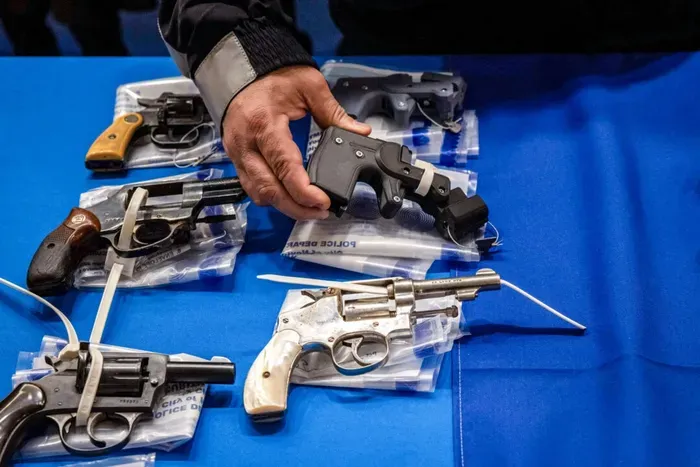
Ghost guns refer to untraceable firearms manufactured without valid serial numbers. The lawsuit, filed Friday in the Superior Court of the State of California in San Francisco, targets Florida-based Gatalog Foundation Inc., the owner of thegatalog.com, CTRLPew LLC, and the owner of ctrlpew.com. Individual defendants in the case include people associated with these companies.
In addition to accusing them of distributing the computer code for 3D printed firearms and prohibited accessories, the defendants promoted and facilitated the unlawful manufacture of these devices, all of which violated state regulations, according to the lawsuit.
Bonta claimed that the state was facing a “public safety crisis” due to the proliferation of ghost guns. In 2015, law enforcement agencies in the state recovered 26 ghost guns from suspected criminal activity. Between 2021 and 2025, an average of 11,000 ghost guns and auto sears were recovered per year, according to the complaint. Auto sears, also known as glock switches, are devices that allow people to quickly convert a semiautomatic gun into a fully automatic machine gun.
“California has responded with laws that specifically prohibit 3D printing firearms and prohibited firearm accessories without a license to manufacture firearms, and since 2023, has also prohibited the distribution of computer code for printing them to those without a license,” the lawsuit states.
“As of January 1, 2026, it is also unlawful to knowingly, willfully, or recklessly aid, abet, promote, or facilitate the ‘unlawful manufacture of firearms,’ which includes the manufacture of a firearm using a 3D printer by an unlicensed person.”
The lawsuit accused defendants of ignoring these prohibitions, and providing computer code and instructions to make over 150 different designs of firearms and accessories via thegatalog and ctrlpew websites.
The lawsuit seeks to stop defendants from spreading 3D-printed firearms and prohibited accessories in the state.
In its statement, Bonta’s office accused defendants of seeking to gain an “unfair advantage” over responsible, licensed firearms businesses by selling products and services that skip background checks of customers.
Defendants’ activities support the conversion of legal weapons into illegal weapons, it said, adding that they induce the state’s customers to buy firearm-related products, while “deceptively failing” to notify buyers that using the products for their intended purpose would constitute a crime in California.
“These defendants’ conduct enables unlicensed people who are too young or too dangerous to pass firearm background checks to illegally print deadly weapons without a background check and without a trace,” Bonta said.
“California is building a model for policymakers in other states and in Congress to comprehensively address the ghost gun crisis nationwide.”
The Epoch Times was unable to reach Gatalog Foundation and CTRLPew for comment.
In 2022, the previous administration introduced regulations targeting ghost guns, requiring individuals who assemble homemade firearms to include serial numbers on their products.
The regulations also mandate background checks on people who buy gun-assembly kits from dealers.
A lawsuit was filed against the ghost gun regulations. In March last year, the U.S. Supreme Court upheld the rule in a 7–2 vote.
State Regulations
Actions have been taken at the state level on ghost guns. In August, the Minnesota Supreme Court ruled that ghost guns do not require a serial number under the state’s regulations.
Minnesota’s prosecutors had argued in court that all guns must have serial numbers in the state, even if not required by federal law, including firearms manufactured prior to 1968.
Justice Paul C. Thissen wrote in the 4–2 majority ruling that the prosecutor’s interpretation of a state law to support serial numbers in guns would have “the unfortunate and unnecessary effect of turning a large group of currently law-abiding Minnesotans, like those who own rifles and other firearms manufactured before 1968 (often family heirlooms), which are not National Firearms Act firearms and lack serial numbers, into unsuspecting criminals,” the judge wrote.
“We should exercise caution before criminalizing the conduct of a large group of Minnesotans who have never understood their behavior to be criminal.”
According to data from online ammunition seller Ammo, 3D-printed firearms are illegal in the District of Columbia and seven states, as of July 2025—Washington, Oregon, Hawaii, New York, Rhode Island, Connecticut, and Delaware.
The manufacture of 3D-printed guns is “explicitly illegal” in Hawaii, Delaware, Washington, and Rhode Island, it said. Possessing unregistered, unserialized 3D-printed firearms is banned in New York, Connecticut, and Oregon.