
By Owen Evans
At least nine vessels have come under attack since the U.S.–Israel military operation against Iran began on Saturday.
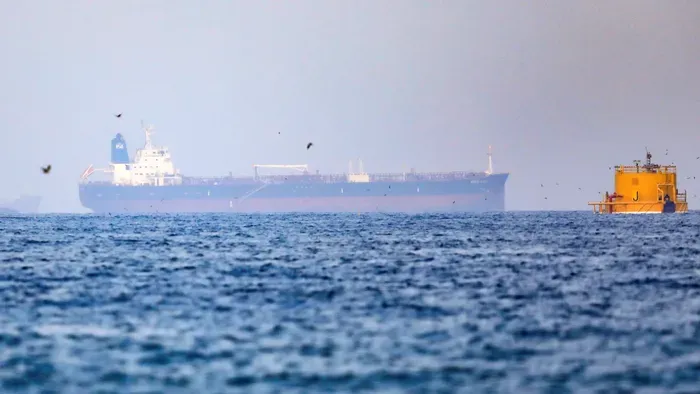
About 300 oil tankers remain inside the Strait of Hormuz, according to vessel tracking data from Vortexa and Kpler.
According to a report by the International Energy Agency (IEA), the Strait of Hormuz, through which an average of 20 million barrels per day of crude oil and oil products were shipped in 2025, is one of the world’s most critical oil transit chokepoints.
It said that with around 25 percent of the world’s seaborne oil trade transiting the Strait, and options to bypass it being limited, any disruption to flows through the Strait would “have huge consequences for world oil markets.”
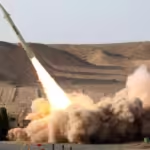
Iran’s Revolutionary Guard said on Thursday that it had hit a U.S. tanker in the northern part of the Gulf and that the vessel was on fire.
The hull of another vessel, the Bahamas-flagged crude oil tanker Sonangol Namibe, was likely to have been breached after being hit by a blast while anchored near Iraq’s Khor al Zubair port, U.S. representative company Sonangol Marine Services said on Thursday.
The vessel was approached by an unknown small vessel at 1:20 a.m. local time on March 5.
One oil tanker anchored off the coast of Kuwait was damaged by an explosion on March 4, according to the UK Maritime Trade Operations (UKMTO).
The UK agency did not identify the tanker.
UKMTO said it received a report of an incident about 30 nautical miles southeast of Mubarak Al Kabeer, Kuwait. The master of the tanker reported witnessing and hearing a large explosion on the vessel’s port side before seeing a small craft leave the area.
The vessel also took on water following the blast, though no fires were reported, and the crew was confirmed to be safe.
Earlier, UKMTO said there was “oil in the water coming from a cargo tank.” In an update, the agency said the discharge from the tanker is ballast water.
Authorities are investigating the incident, UKMTO said.
The maritime monitoring body also advised vessels in the area to transit with caution and report any suspicious activity to UKMTO as tensions remain high across the region.
Renewed attacks on tankers in the Gulf are set to increase oil and gas prices.
Oil prices increased on Thursday by around 2 percent, and have risen by 15 percent since the war started on Saturday.
On March 2, QatarEnergy said it halted LNG production after Iranian military attacks on key facilities, sending European gas prices rising by as much as 45 percent.
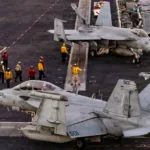
On March 4, U.S. Central Command reported that U.S. forces had attacked more than 20 Iranian warships.
A U.S. submarine sank one such Iranian warship with a torpedo, Pentagon chief Pete Hegseth announced on March 4. He said the attack was the first time a U.S. submarine has employed such a weapon to sink an enemy ship since World War II.
In a Goldman Sachs Exchanges podcast on March 2, Daan Struyven, co-head of Global Commodities Research and head of oil research at Goldman Sachs, said the immediate impact is being felt in export flows through the Strait of Hormuz.
Struyven said that if the disruption drags on, with storage capacity exhausted, production shut off, and the Strait of Hormuz closed for an extended period, there could be “demand destruction.”
Demand destruction is when prices rise so high that consumers and businesses are forced to reduce their use of a product.
“And we typically find that in oil markets, to generate substantial demand destruction, prices may have to rise into triple-digit territory,” he added.
Ryan Morgan and Reuters contributed to this report.