
By T. J. Muscaro
CAPE CANAVERAL, Fla.—For the first time in 60 years, NASA has two crews in quarantine at the same time, awaiting the launch of their mission into space.
As the Artemis II crew gears up to fly around the moon, NASA’s SpaceX Crew-12 is getting set to fly to the International Space Station, and it appears their orbital mission will have a significant lunar focus.
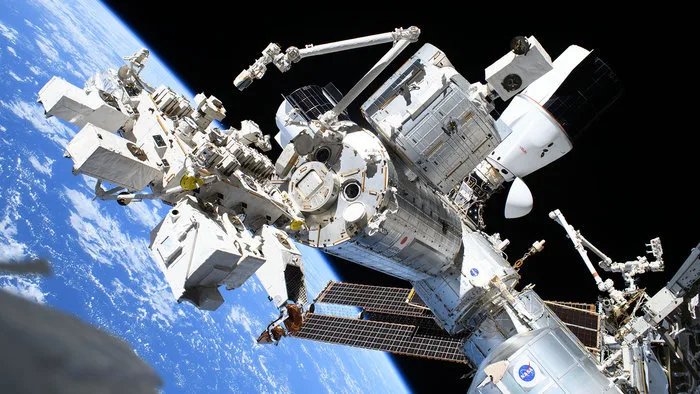
NASA Astronauts Jessica Meir and Jack Hathaway, European Space Agency (ESA) Astronaut Sophie Adenot, and Roscosmos Cosmonaut Andrey Fedyaev could spend up to eight months aboard the floating laboratory as part of the remainder of Expedition 74 and the start of Expedition 75 liveaboard missions.
Their objectives include testing exercise equipment built by the ESA specifically for the Gateway, a space station NASA and its partners plan to put in lunar orbit as part of the Artemis program, and other future exploration missions. The crew will also be conducting lunar landing simulations.
Meir explained that she, Hathaway, and Adenot have already conducted some of those simulations on the ground, but microgravity simulations will help NASA better understand how the transition from Earth’s gravity to microgravity affects astronauts’ ability to land on the Moon safely.
They will conduct simulations at the beginning, middle, and end of their missions, testing their ability to land on the moon after various periods of microgravity.
For context, Apollo 11 astronauts Neil Armstrong and Buzz Aldrin experienced roughly four days of microgravity before making their historic landing.
Crew-12 will also conduct post-mission simulations back on Earth.
If Artemis II proves successful and a lunar lander is completed and cleared to fly, NASA aims to land a human crew on the moon as part of Artemis III, which is slated to launch by 2028.
Elon Musk’s SpaceX and Jeff Bezos’s Blue Origin are the two commercial space companies expected to deliver that first crewed lunar lander to NASA, but the winner of that space race has yet to be determined.
Meir clarified that the Crew-12 simulation system is not provider-specific.
“It’s kind of basic piloting skills and landing skills to look at the problem in general, not for either specific provider at this point,” she said.
Since its inception, the International Space Station’s liveaboard expeditions have focused on collecting data and knowledge to determine how to best send humans on long-duration deep-space missions to the Moon, Mars, and beyond. But for most of the station’s 25-year career, those future missions were hypothetical, found in the cosmic reaches of “someday.”
Now, members of an expedition will set off as those missions back to the Moon are underway. Blue Origin delivered a prototype of its MK-1 lander to Houston for testing; the Gateway space station is in development, and they could find themselves in orbit, talking to their fellow astronauts flying around the Moon.
Meir has been to the space station in 2019, during which she participated in the first three all-women spacewalks with Artemis II astronaut Christina Koch. The Epoch Times asked her if Artemis II and the program’s visual progress toward returning to the moon gave her a greater sense of immediacy about the work she will be doing compared to her last trip.
“I think that it does make it all feel much more real,” she told The Epoch Times.
She explained that everything at NASA was incremental, with new missions building upon successes and lessons learned from previous ones, and credited the possibility of Artemis II to the work done on the space station. But she admitted she did not think a return to the moon would necessarily happen in her lifetime. That changed when she watched Artemis I launch in 2022, knowing that the next time it launched, her friends would be riding on top.
“It’s so exciting to think that we have all of these different prospects, and to think about the work that we’re doing, of course, for the entire last 26 years, all of it has benefited these future missions, and in continuing some of these experiments that will help us with our first landing missions on the moon, is it makes it even more worthwhile and rewarding for us,” she said.
Crew-12’s launch aboard their SpaceX Falcon 9 and Crew Dragon capsule from Space Launch Complex 40 at Cape Canaveral Space Force Station, Florida, will be determined by Artemis II.
Steve Stitch, manager of NASA’s commercial crew program, told reporters on Jan. 30 that the earliest launch opportunity is 6 a.m. on Feb. 11, but that is only possible if Artemis II ground crews and mission managers decide not to attempt a launch in the February window.
If Artemis II launches on Feb. 8, Crew-12 won’t launch until Feb. 19, and if the moonshot attempt a launch but stands down during the countdown, Crew-12 could launch as early as Feb. 13.