
By Zachary Stieber
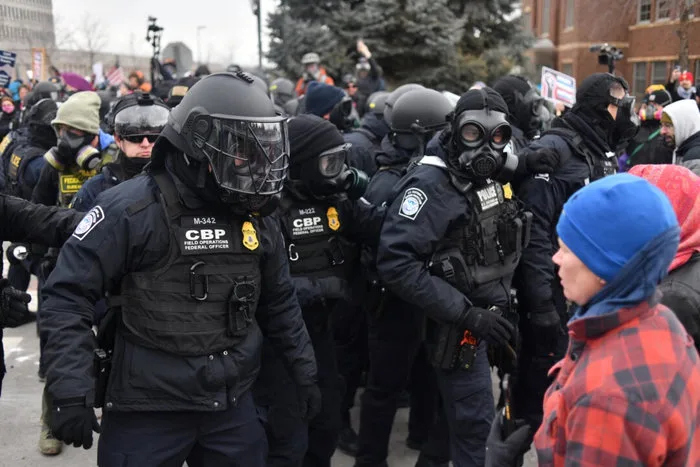
A U.S. appeals court on Jan. 21 paused an order that restricted federal immigration agents from detaining or using tear gas against protesters in Minnesota if they were not obstructing officers.
The U.S. Court of Appeals for the Eighth Circuit issued the one-page order without providing an explanation.
This means that a recent decision from Judge Kate Menendez of the U.S. District Court for the District of Minnesota is no longer in effect, pending the outcome of an appeal.
Menendez ruled on Jan. 16 that federal agents could not detain protesters or use nonlethal munitions or crowd dispersal tools against protesters if the protesters were not obstructing authorities.
U.S. lawyers said in an emergency motion for a stay pending resolution of the government’s appeal that the judge made its decision “based on a handful of contested allegations of wrongdoing by federal officers” and that the U.S. Supreme Court or other higher courts have ruled against similar cases.
“The injunction irreparably injures the government and public interest,” they wrote. “By subjecting enforcement of Operation Metro Surge to the district court’s day-to-day oversight, the injunction irreparably harms the government by superintending officers’ conduct and encroaching on the Executive’s prerogative to enforce the law, violating fundamental separation of powers principles and impeding enforcement of the Nation’s immigration laws.”
Operation Metro Surge is the name of a federal operation that began in 2025 and targets illegal immigrants in the state of Minnesota. The Department of Homeland Security said this week that it has arrested more than 10,000 criminal illegal aliens in Minnesota in recent weeks, including murderers, rapists, and pedophiles.
Protesters have gathered in opposition to the operation.
In the case in question, six Minneapolis residents said officers arrested or threatened them for observing or filming.
“This lawsuit aims to vindicate the rights of the Minnesotans who have been victimized by their own government simply for exercising their First Amendment rights, to end the false sense of impunity that fuels the worst of Defendants’ misconduct, and to ensure that Minnesotans can assemble, observe, document, and criticize Defendants’ activities, safely and unburdened by the fear of retaliation,” the lawsuit stated.
Menendez said in her ruling that the plaintiffs were engaged in activity protected by the First Amendment and that the responses by law enforcement chilled that activity.
She enjoined agents from arresting or detaining people “who are engaging in peaceful and unobstructive protest activity” and from using crowd dispersal tools and nonlethal munitions, such as pepper spray, against peaceful protesters.
She also wrote, “The act of safely following Covered Federal Agents at an appropriate distance does not, by itself, create reasonable suspicion to justify a vehicle stop.”
Tricia McLaughlin, a Department of Homeland Security official, said after the ruling that the agency was carrying out “appropriate and constitutional measures to uphold the rule of law and protect … officers and the public from dangerous rioters.”